


Introduction
For those of you who don’t know me, my largest short ever was on Lennar (LEN), one of the nation’s largest homebuilders. I chose Lennar because of their exposure to markets which were struggling the most. Margins have continued to decline, the markets have continued to deteriorate, and the thesis has played out.
The real estate industry has spent the last few years propping up a “housing shortage” narrative. The real shortage is affordability. In this housing cycle, total cost of homeownership relative to income had eclipsed the 2007 peak. Combine that with management teams who keep promising the inflection is one quarter away, and you get a sector that has fooled a lot of people who don’t bother to look at the data.
I was interviewed for a piece last year because I was the only short the journalist could find. Institutions were quoted bullish, Warren Buffett (Berkshire) bought the stock, and I was called an idiot. Since that interview, the stock is down roughly 45%.

I still have a short position in Lennar both personally and in the fund. But what I’ve found at KB Home looks like an even better setup. The combination of the narrative, lazy sell-side modeling, and a series of financial gimmicks by management has created an opportunity for anyone willing to look under the hood.
Unless I am missing something, this is one of the cleaner short setups I have seen.
The Setup
KBH is concentrated in the markets that were hottest in 2021, and those are the markets deteriorating the most today. The result has been serious margin compression.
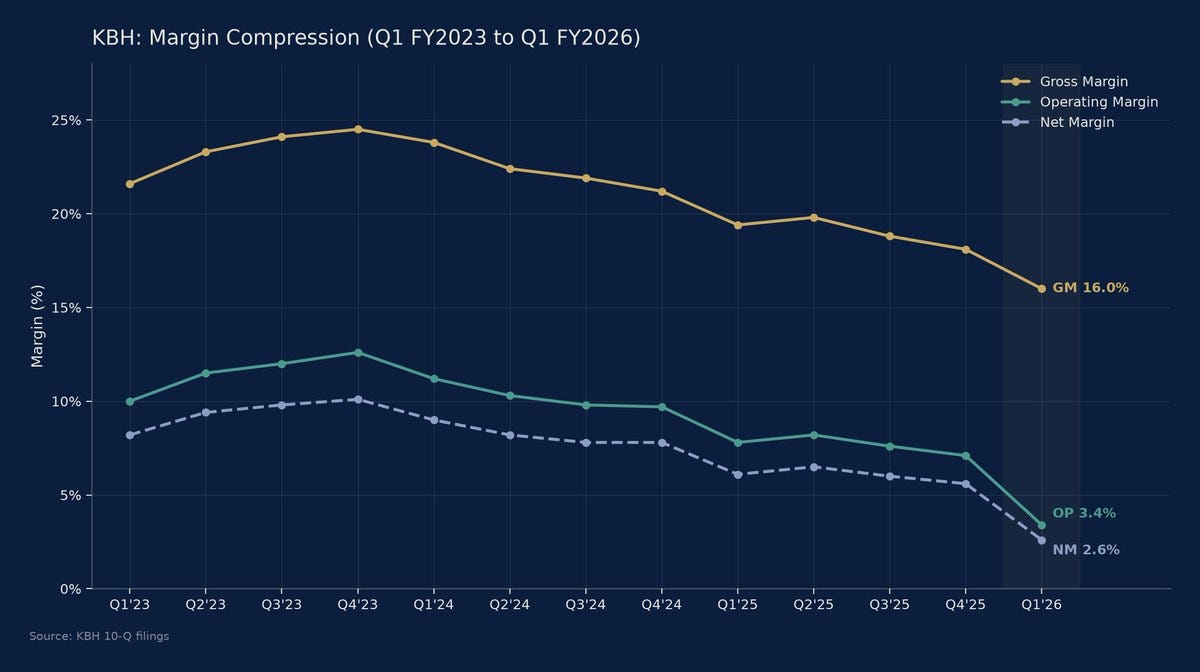
Like the rest of the industry, KBH management keeps insisting the weakness is temporary, yet every quarter it gets worse.
What’s interesting about KBH specifically is they’ve dug a hole that I don’t think is widely understood, and it creates a uniquely mechanical short.
The Hole
KB Home is a clean example of what the homebuilding industry does at every cycle peak: kick the can down the road.
The logic is always “things are bad now, but they’ll get better soon”, with no real analysis of the future. So as fundamentals deteriorate, KBH cut land acquisition and ramped buybacks.
Buybacks juice EPS, so the deterioration looks milder than it is. But two things are now true at once: they’re running out of cash to keep buying back stock, and they have less land in the pipeline to convert into future revenue.
In Q1 FY26 the company posted negative free cash flow of $138.6M and still deployed $50M in debt-financed buybacks. In Q3 FY25, KBH slashed land acquisition. Investments in land and land development fell 38% YoY in Q1 FY26.
The land deals didn’t pencil, so management chose to buy back stock instead. As a homebuilder, if you don’t buy land, you can’t generate revenue. That trade-off is the foundation of the short.
The Mechanical Problem
To open communities and produce homes, a builder has to option lots roughly 18–24 months in advance. Management confirmed this lag on the Q1 call and guided that community count peaks in Q2 FY26 and steps down in the second half. The lot position has already deteriorated.
The pipeline collapsed in the most recent quarter alone:
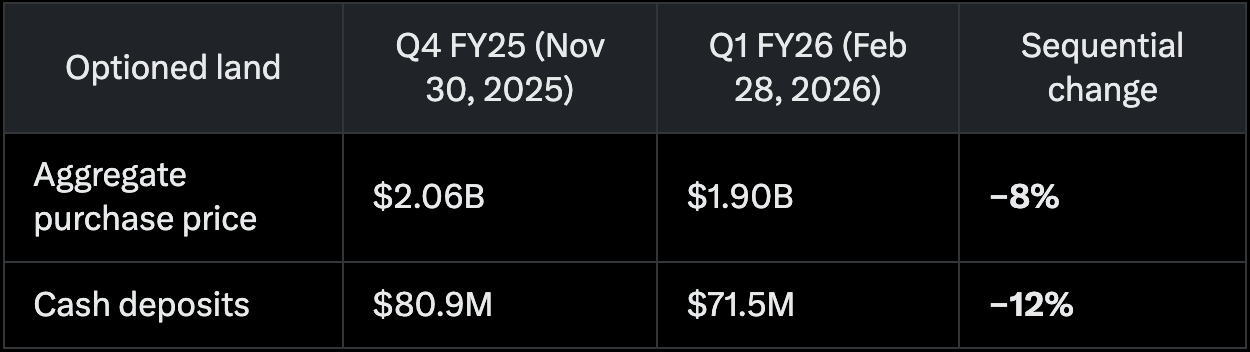
That’s in a single quarter. On a YoY basis it’s worse: aggregate purchases have dropped from $2.53B (Q1 FY25) → $1.90B (Q1 FY26), or −25%.
This is not lots getting cheaper. This is a drop in volume. Management itself disclosed in the FY25 10-K that option lot count fell 27% YoY, and explicitly attributed the drop to “abandonment of 24,596 previously controlled lots that no longer met our underwriting criteria.”
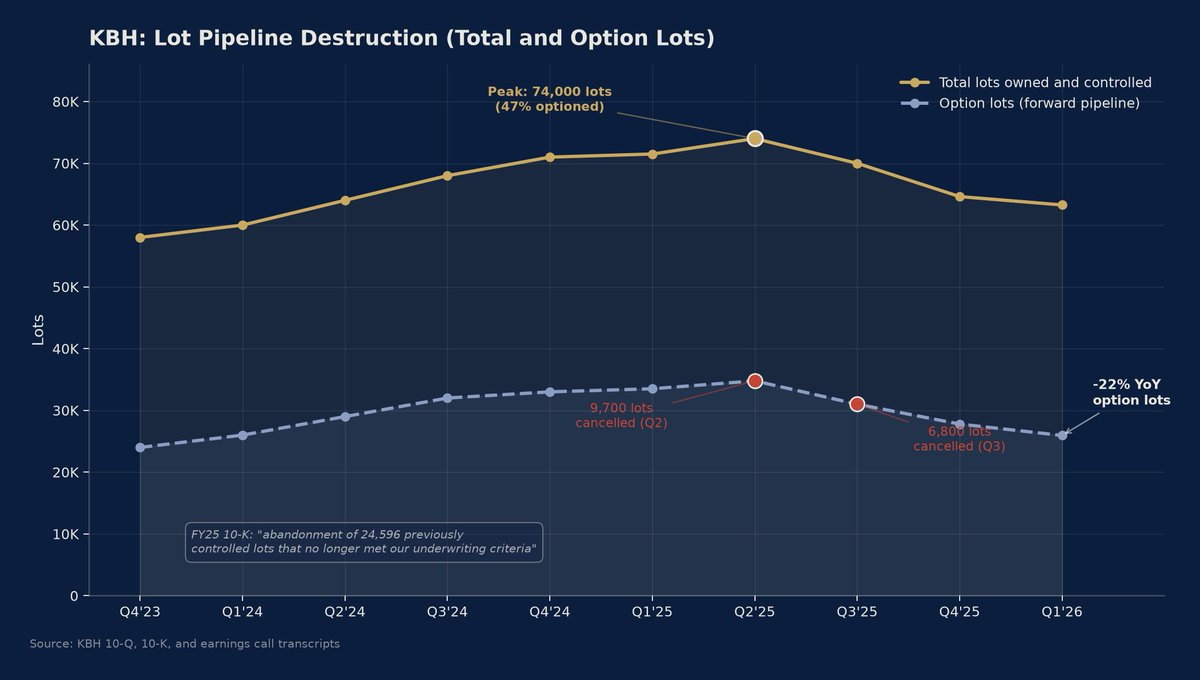
Those decisions are made. You cannot retroactively acquire lots you walked away from. That fixes the FY27 community count at roughly 218–245 versus 276 today.
Run that community-count decline through to deliveries, and the volume line falls to roughly 6,600-8,900 homes in FY27, against a Street still modeling 10,500-12,500. FY26 management guidance is now 10,000 to 11,500 deliveries, already cut from the original 11,000 to 12,500 guide issued at Q4 FY25
The Real EPS
The volume decline is locked in. Only the magnitude is in question. Take management’s own delivery math and walk it down to earnings, base case, ~7,920 deliveries at the current average selling price produces about $3.58B of revenue.
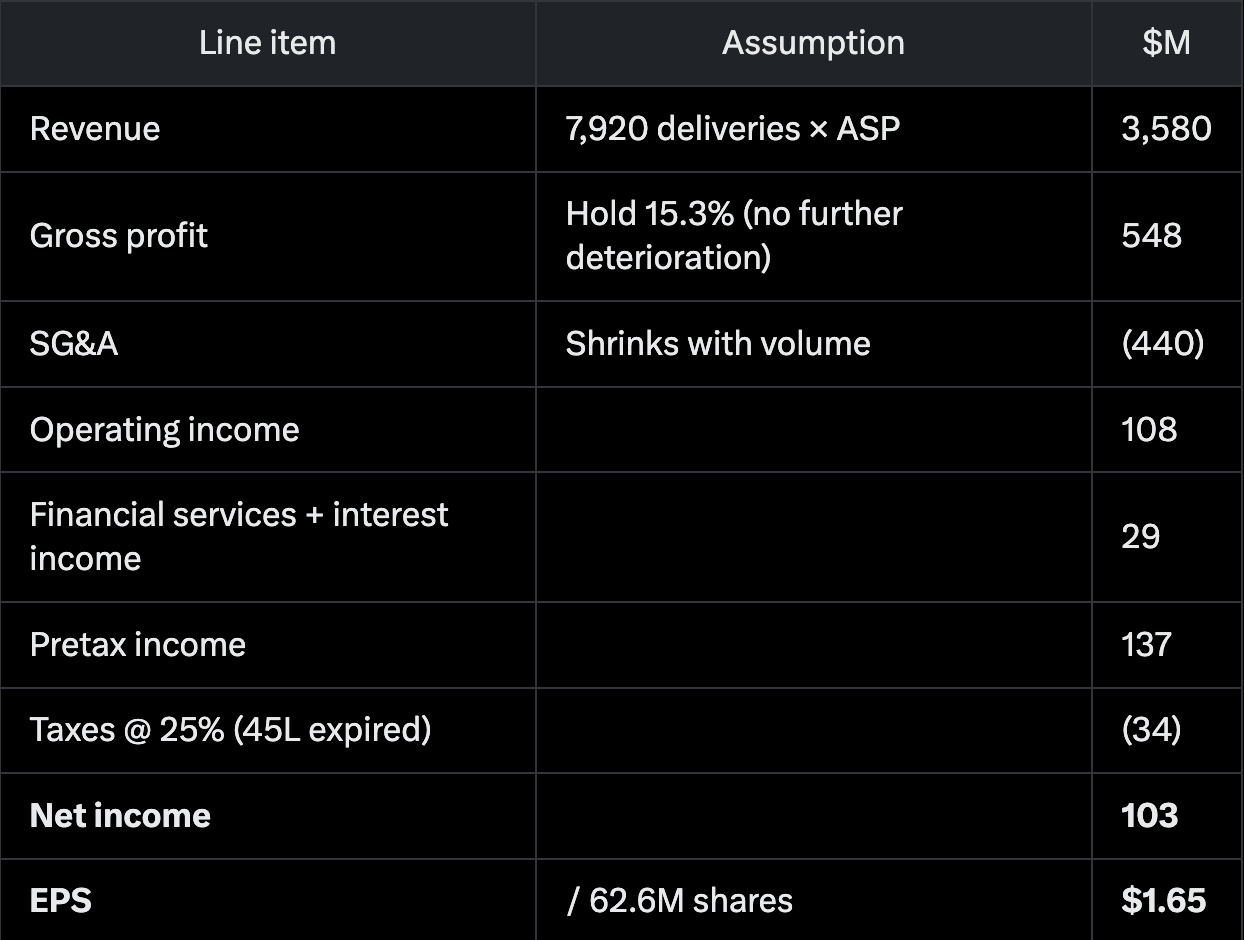
Net income lands near $103M, or about $1.65 per share on the current count. Being conservative and allowing for some buybacks, let’s call it $2.00.
At a p/e of 10, that’s a $20 stock.
Consensus is Wrong
So why is the Street still modeling $4–6+ for FY27? A few reasons:
They’re extrapolating the Built to Order mix-shift margin story. Management has been vocal about a 300–500bp gross-margin improvement from a higher Built to Order mix, and analysts are running that through their models without adjusting the volume line down enough.
Community count is a non-standard KPI. Most sell-side models are revenue/EPS-driven; they don’t build bottom-up from lots → communities → deliveries.
Guidance anchoring. Full-year revenue guidance of $4.8–5.5B gives analysts a range to cluster around. Nobody wants to be 40% below the company’s own guide until the company cuts again.
Volume is going lower. The only debate is the magnitude. Even a generous bull scenario lands EPS around $2.40 vs. the $4–6 consensus. The stock is priced for a business that the lot pipeline structurally cannot deliver.
The Acquisition Case (Biggest Risk)
Here is the strongest argument against this short, and it is a real one. Book value provides a floor.
In 2026, Berkshire Hathaway agreed to acquire Taylor Morrison. This shows it’s possible for capital to be deployed into public homebuilders at premiums to where they trade, not where they’re worth. A similar bid for KBH at any premium to stated book wipes out the short overnight. That is the single largest risk to this thesis.
The whole short comes down to one thing: is book value actually the floor everyone assumes it is?
I don’t think it is.
Book “Value”
The book is lower quality than it looks. More than half of the entire inventory sits in West Coast land, California-led, the most expensive and affordability-stressed region in the country, currently earning a 14.4% gross margin and falling. The single largest concentration of the company’s capital is its lowest-returning, most cyclical asset.
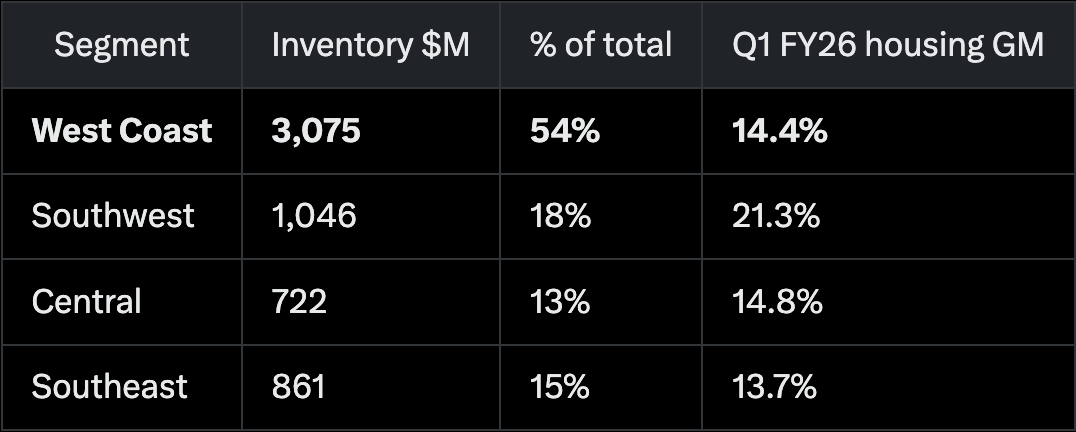
The book is overstated. In Q1 FY2026, KB Home flagged 16 communities with $196.1 million of carrying value for impairment review, up from 11 communities and $154.1 million one quarter earlier. The at-risk pool is growing fast. Impairment charges taken: zero.
Under GAAP a community is only written down when carrying value exceeds its undiscounted future cash flows, so a community can earn a 13% margin, far below the cost of capital, and still pass the test. The land is not worth what it is carried at on any return basis, but the rules do not force the markdown until cash flows actually turn negative. Management even hedges in the filing that results “could differ substantially... especially in periods of volatile housing market.”
Haircut the land for the gap between carrying value and what it can realistically earn and economic book falls fast. A realistic 15% to 20% land haircut puts economic tangible book in the high-$40s to low-$50s, against a stated $61.53.
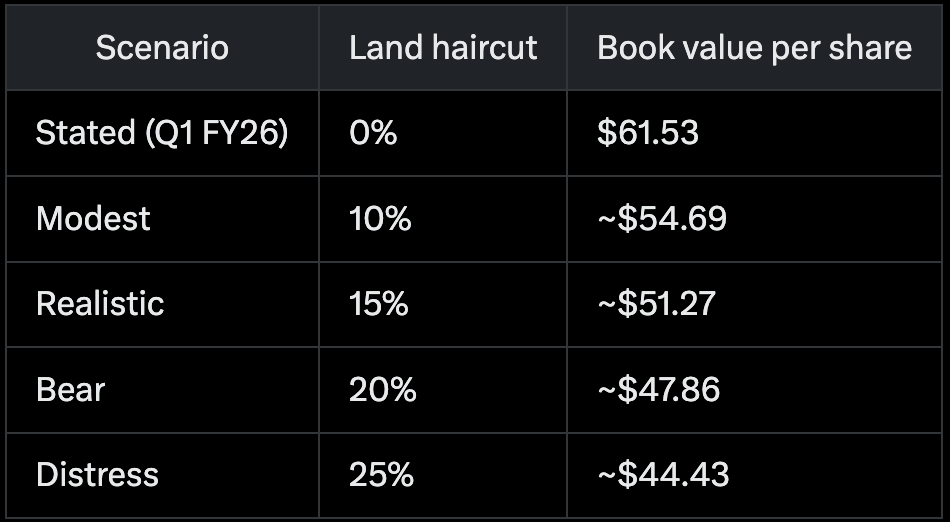
The second leg of the short isn’t just that book is overstated, it’s that book actively erodes between now and the end of FY27. The usual protection for a cheap-on-book stock is that book compounds while you wait. That mechanism has reversed.
Book value per share grew ~10% in FY25, but only because buybacks retired 13% of the shares. Total equity actually fell ~4% in FY25. In Q1 FY26, book value per share went flat-to-down for the first time, to $61.53, because earnings collapsed 70% and no longer cover the payout.
From here, the equity trajectory bifurcates based on a single question: do FY26 H2 and FY27 generate net income, or net losses? The whole bear thesis (margin compression, ASP rolling, lot starvation feeding through to delivery shortfalls) implies the latter.
Similarities to 2008
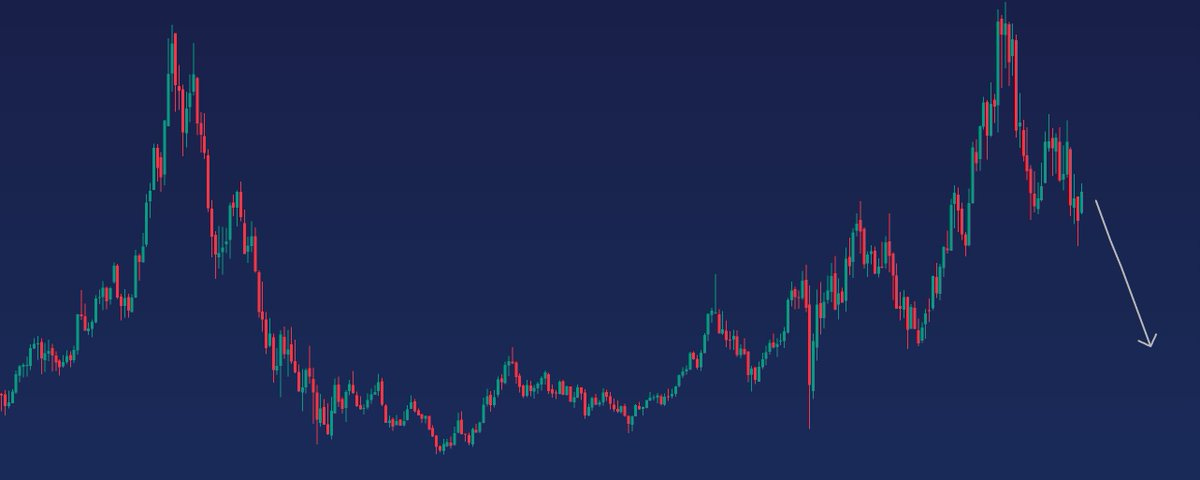
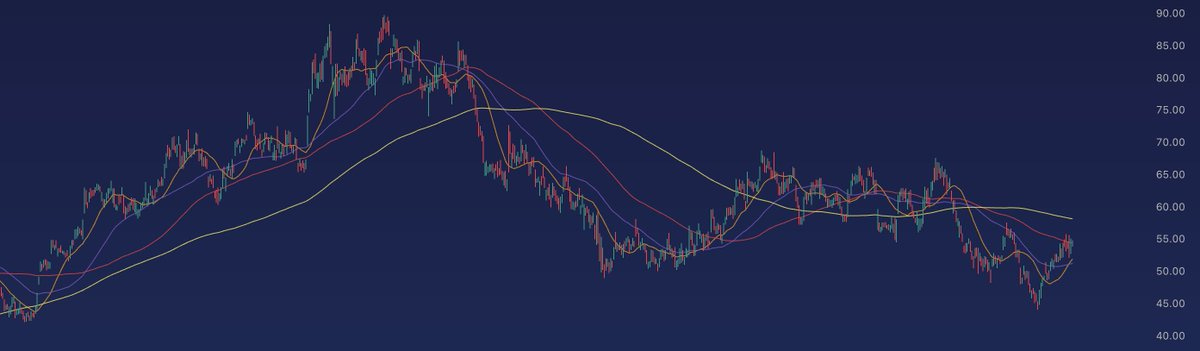
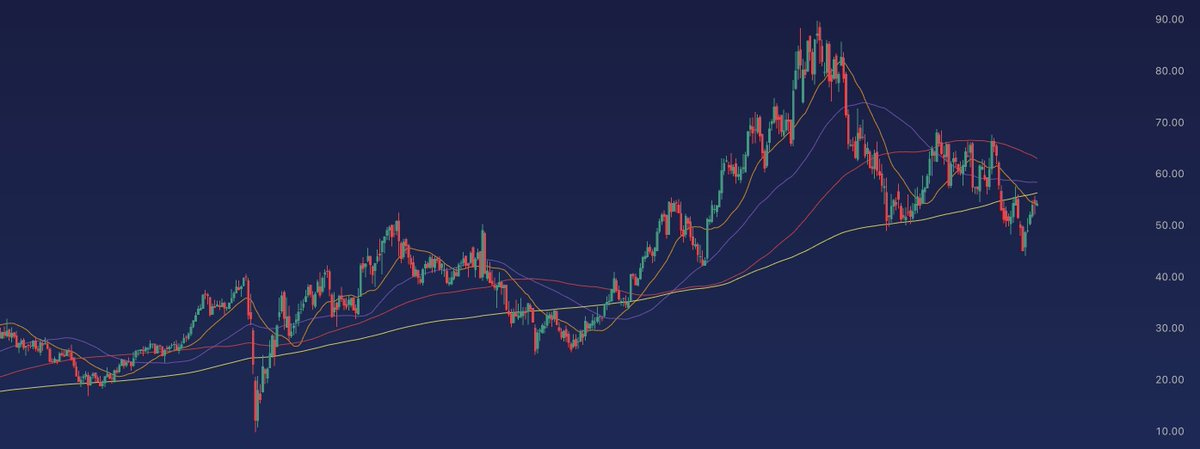
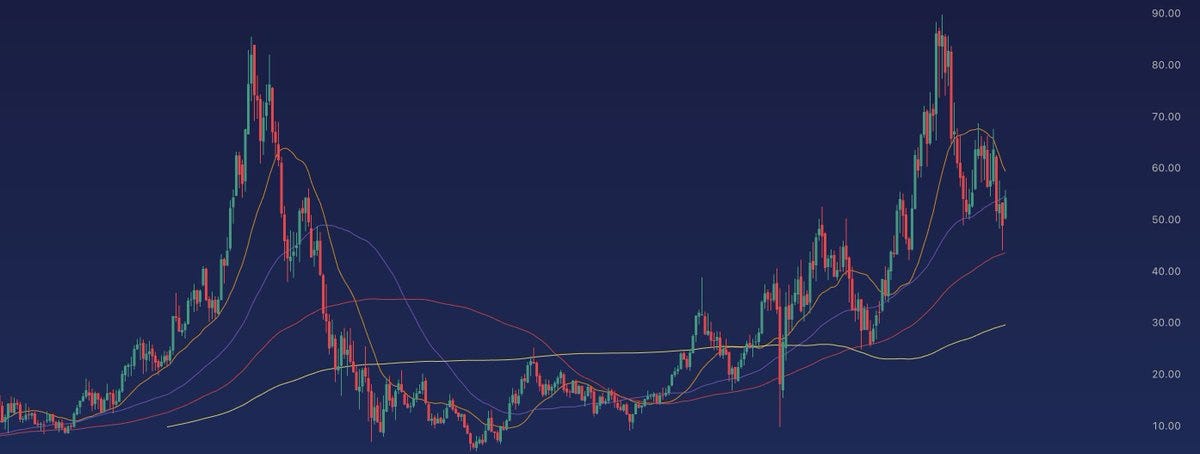
The technical picture looks like 2008. So do the financials. Margin compression, ASP rolling, backlog falling, optioned-lot abandonment. The peak-to-trough cadence on every operating metric is tracking the FY07 trajectory roughly one quarter lagged.
In the last cycle, KBH equity went from $2.92B at FY06 peak to a trough of $377M at FY12, an 87% drawdown. Over $2.5B of equity vaporized through exactly the combination of mechanisms above: cumulative net losses of ~$2.3B FY07 to FY11, a $514M DTA valuation allowance in FY07, and continued dividends until the cut. Book did not go negative, but it lost 87% of its value while the stock lost 90%. That is the calibration point for how much room there is below today’s $61.53 BVPS if the cycle plays out even a quarter of the way to the FY08 trough.
CFO Departure
The bear thesis on KB Home has so far been mechanical: lot starvation, buyback exhaustion, economic book below stated book. The CFO departure is the behavioral leg of the same argument. It is the kind of signal that, in this sector, has historically preceded the cycle’s worst impairments by 6 to 18 months.
CFO Robert R. Dillard resigned in April, roughly 13 months after he took the role in March 2025. He came in from Sonoco Products at a top-tier compensation package. CFOs in the homebuilding sector do not voluntarily walk away from that kind of seat 13 months in for “personal reasons” with the cycle visibly rolling over.
The resignation was disclosed two months before a guided-down Q2 print, a quarter that management itself has telegraphed as the peak community count, with deceleration into H2.
The 2006 KB Home precedent:
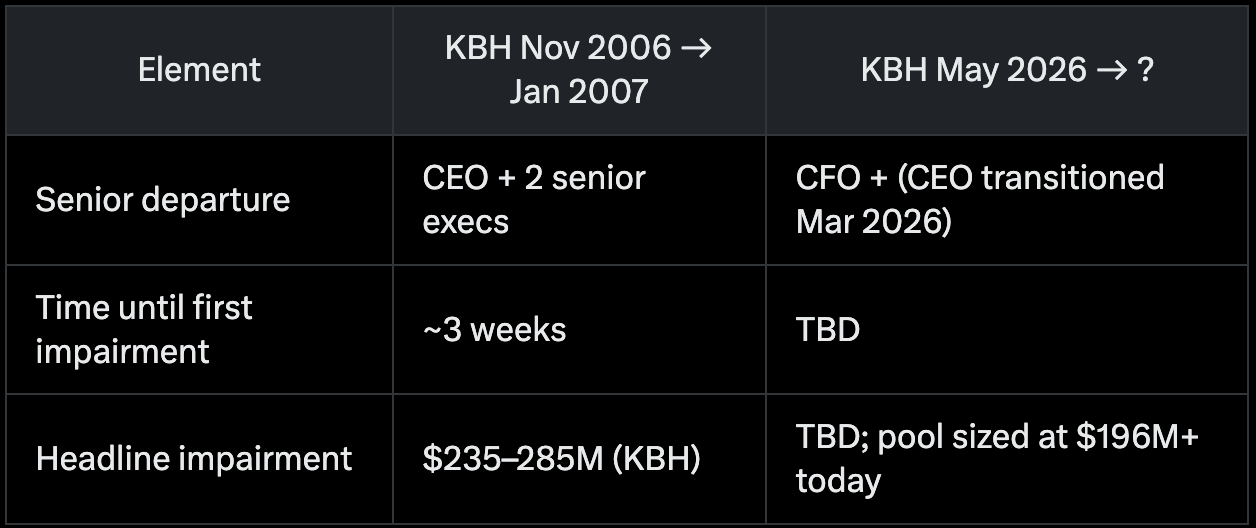
In November 2006, three KB Home executives (CEO Bruce Karatz, head of HR, and Chief Legal Officer) departed in the same 48-hour window. Three weeks later, KBH disclosed a $235 to 285M Q4 2006 inventory impairment charge.
In this cycle, KBH also transitioned its CEO. So the company has now turned over both its CEO and its CFO inside a 70-day window heading into the worst quarter of the cycle.
The Technicals
Here are the technicals if you are into that. I think they are looking quite bearish on every timeframe.
Daily
Weekly
Monthly
Price Target
Consensus price target of ~$55 is built on a Street EPS model that ignores lot starvation.
Earnings multiple - Apply a 9 to 12x multiple to my $1.65 FY27 EPS = $15 to $20. The market won’t fully discount to trough EPS, so I weight this lightly.
Economic book - Stated BVPS bridges to ~$47.50 combined with ~$450M of cumulative losses = ~$37.50 economic BVPS. At 0.7 to 0.8x P/B: $26 to $30.
The $35 target is slightly above where the 200-month moving average will be in about a year. This target is a ball park to be directionally correct and weighs the EPS method, BV method, and the technicals to arrive at this number.
Risks to the Short (Bull Case)
1. Acquisition / Takeout
This is the biggest tail risk which was discussed above. Even if TBV is overstated, all it takes is someone else to overpay.
2. Mortgage Rate Shock Down
If the 30-year fixed drops from ~6.8% to ~5.5%, demand snaps back fast. KBH’s BTO model means a sudden demand surge would flow quickly into orders and then closings.
3. 45L Tax Credit Expiry Creates a One-Time Pull-Forward
The 45L energy efficient home credit ($2,500–$5,000 per home) expires June 30, 2026. KBH builds to Energy Star standards and qualifies. Any closings pushed into Q2 to beat the deadline would boost Q2 revenue and margin, and management likely knows this. It won’t rescue FY2027, but it could make Q2 look better than expected and squeeze shorts near-term.
Conclusion
KBH is a compelling short when you stack the pieces together: margin compression, the optioned-land collapse, shrinking community count, the buyback engine running out of runway, the CFO departure, and the technical setup. It is looking eerily similar to 2008, with less magnitude.
I will reassess the thesis after the earnings print. I am always open to changing my mind when new data presents itself.
Contact
If you are an accredited investor and interested in investing in Outlier Capital, please reach out at matt@outliercapitalmanagement.com or on the contact form on the website.
Disclaimers
This report is published for informational and educational purposes only. It is not, and should not be construed as, investment advice, a recommendation, an offer to sell, or a solicitation of an offer to buy any security.
As of the date of publication (June 22, 2026), Outlier Capital Management and/or its principals, affiliates, partners, and clients hold a short position in KB Home (NYSE: KBH), directly or through derivatives such as put options. We may increase, decrease, cover, or otherwise change our position at any time without notice and without any obligation to update this report.
This report is based on information believed to be reliable, including KB Home’s SEC filings (10-K, 10-Q, 8-K), press releases, earnings transcripts, and other public sources cited inline or referenced in the appendix. We make no representation or warranty, express or implied, as to the accuracy, completeness, or timeliness of the information presented. SEC filings, market data, and third-party sources may contain errors or be superseded by subsequent disclosures. All figures, dates, and citations were current as of the date of publication and may be stale by the time of reading.
This report contains forward-looking statements, projections, opinions, estimates, and scenario analysis, including but not limited to FY26 and FY27 earnings, delivery, community-count, gross-margin, impairment, book-value, deferred-tax-asset, and price-target estimates. These are based on assumptions that may prove incorrect. Actual results may differ materially from the estimates presented. No representation is made that any scenario, projection, or price target will be achieved. Past performance and historical analogs are not indicative of future results.
This report reflects our views as of the date of publication. We have no obligation to update, revise, correct, or supplement this report based on new information, changes in market conditions, errors discovered after publication, or any other circumstance. Our views and our position in KBH securities are subject to change at any time without notice.