



Throughout my career, I have seen many multibaggers. Some of which I caught, and some of which I missed and later thought “man this one was obvious I can’t believe I missed it”
Yet few stocks I have studied have looked as obvious to me as LMND.
This article will show from a high level, why I think so. This is not investment advice, these are just my thoughts and how I’m looking at it.
The thesis is simple. It’s pretty much: a superior user experience & brand with better pricing than competitors, the company has incredible operating leverage, and a massive TAM to grow into.
What is Lemonade
Lemonade is an AI native insurance company which was founded in 2015. They have spent 11 years of upfront work to quietly disrupt the entire insurance industry. They currently offer car, renters, home, pet, and term life insurance.
Lemonade is still a tiny company sitting inside a massive market. The company is currently at $3.95B market cap. For context, Progressive is a $119B company.
Insurance may sound boring to you, yet that is exactly why I love the stock so much. Because it’s a boring, simple industry, begging to be disrupted by AI.
At its core, insurance is simply collecting premium, in exchange for a promise to pay the customer out. No physical product with a supply chain, inventory, etc. Just a promise with some math behind it. That’s it.
This is the most perfect business for AI to come in and disrupt.
The industry is dominated by dinosaurs stuck on the old way of doing things. Not only that, most people hate the legacy insurance companies due to them fighting customers when it comes time to pay them out, and by making the entire process of getting claims paid a nightmare.
Lemonade aims to change all of that. Their entire foundation is built on AI. They use AI to price customers more effectively, but for many other parts of their business as well. They use it to process claims, for fraud detection, for operations, for marketing, sales and more. This is what allows them to have lower costs, a better user experience, and incredible operating leverage.
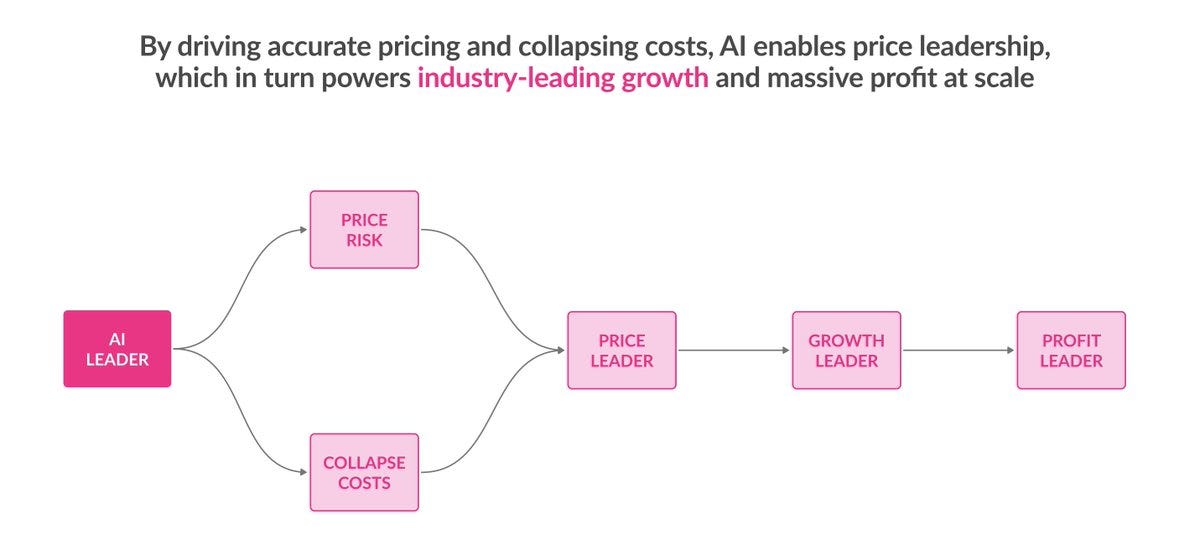
User Experience & Brand
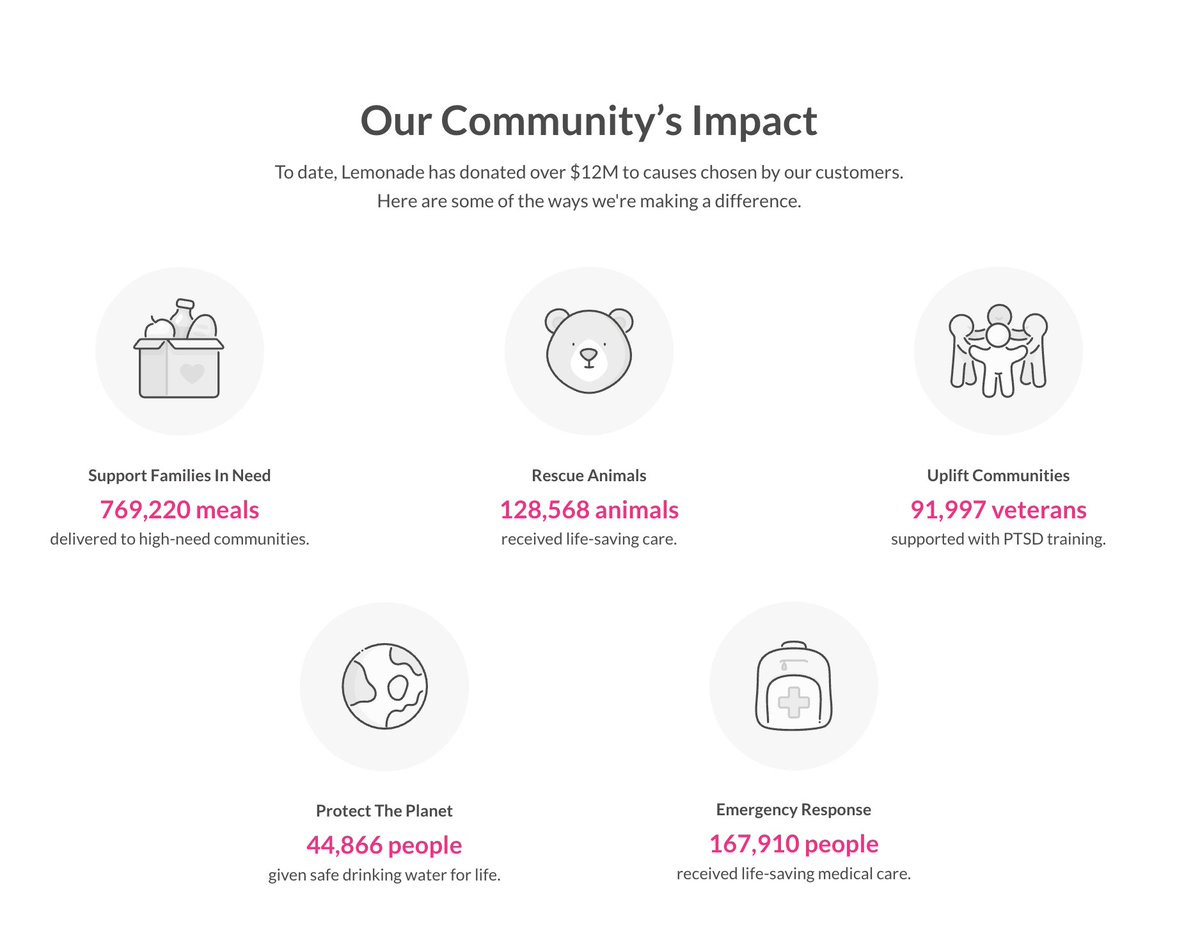
Lemonade is developing a brand that people love, which is rare in the insurance industry. They do this through their giveback program and user experience.
The giveback program is their attempt to develop trust that has been broken by legacy insurers by fighting customers when it’s time to pay up. Lemonade’s idea is to develop trust by flipping the incentive.
How it works: people are placed into cohorts and select a charity of their choosing. If that cohort claims come in under expectations and there is leftover, that surplus of the customer’s premium is donated to charity.
This is a tiny price to pay for the value of being an insurance company customers can finally trust. It can be looked at as a form of marketing spend, to strengthen their brand, while also having a positive impact on the world.
What is more important though, is the user experience. Their user interface on both the app and website is super easy to use. What is unique to Lemonade though, is the claims payout process.
Roughly half of all claims are paid out instantly (3 seconds), with the long-term goal of getting to 90%. They use AI to run 18 different anti-fraud algorithms, and when a claim is more complex or is flagged for potential fraud, then a human gets involved.
This is an incredible experience for the consumer that is the complete opposite of dealing with legacy insurance.
To give you an example of my experience with filing a claim with State Farm, I had to have multiple lengthly phone calls during work hours, dealing with them not answering the phone and only being able to speak when convenient for them. The process went on for 2 weeks to get paid out. It was a nightmare.

To be able to go on your phone, and get claims paid instantly is an incredible improvement in the traditional experience of getting claims paid.
TAM
Lemonade offers renters, homeowners/condo, car, pet, and term life insurance. They don’t just operate in the US, but in Europe as well.
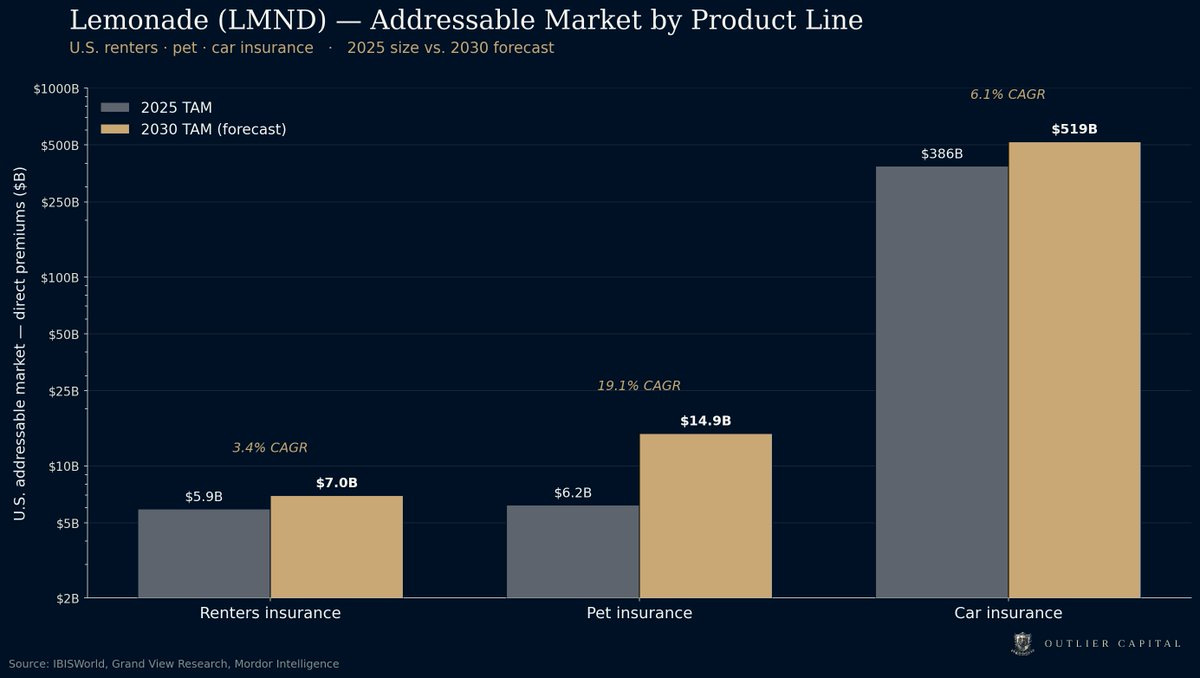
The total TAM for US insurance for Lemonade’s core products (car, pet, and renters insurance) is roughly $398 Billion. Their market share is roughly 6.7% for renters (estimated), 7.9% for pet, and 0.06% for car. With a total market share of roughly 0.28%. This is excluding homeowners and life insurance.
In 2030, the TAM is expected to grow to $540.9 Billion. At a high level, if you assume LMND can go from 0.28% of market share to 0.5% on their core products in the US market, in 2030 they would have $2.7B in IFP. At 1.0% market share, they would have $5.4B in IFP.
This is quite an achievable feat for them, and that’s excluding life and homeowners insurance, and Europe.
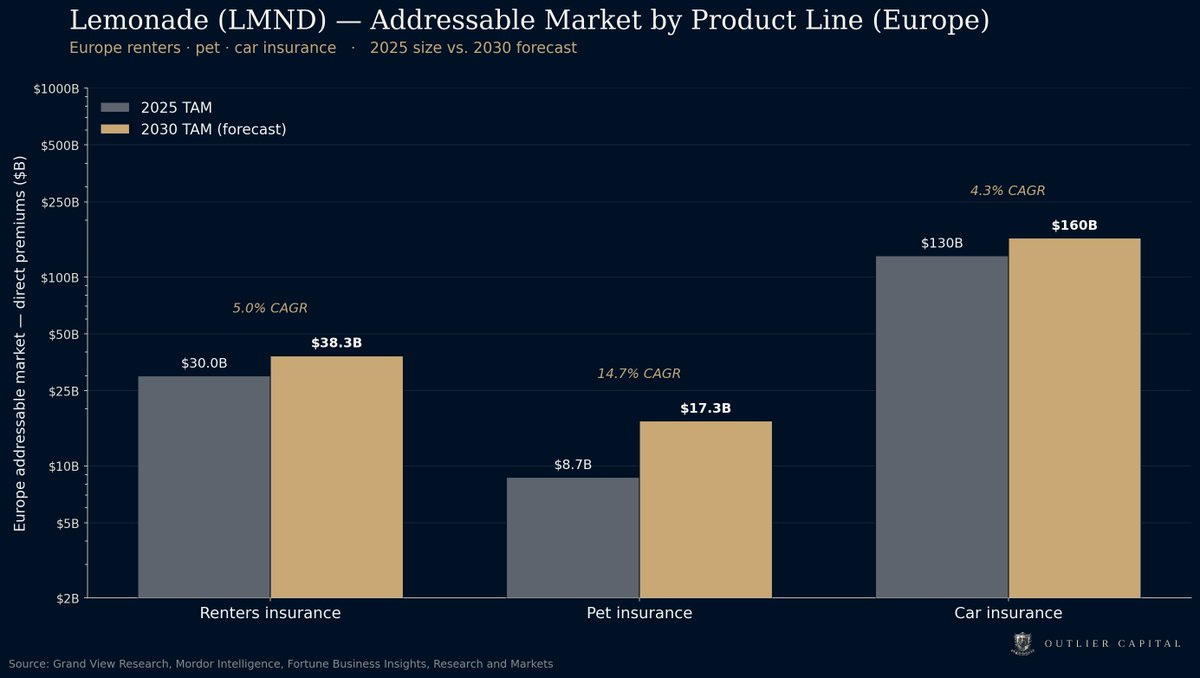
In Europe, Lemonade currently only operates in the UK, Germany, the Netherlands and France. The TAM for their core products there is roughly $168.7B with Lemonade having a market share of roughly 0.04%.
The market is expected to grow to $215B in 2030. Combined with the US, the TAM for Lemonade’s core products, is $755.9 Billion.
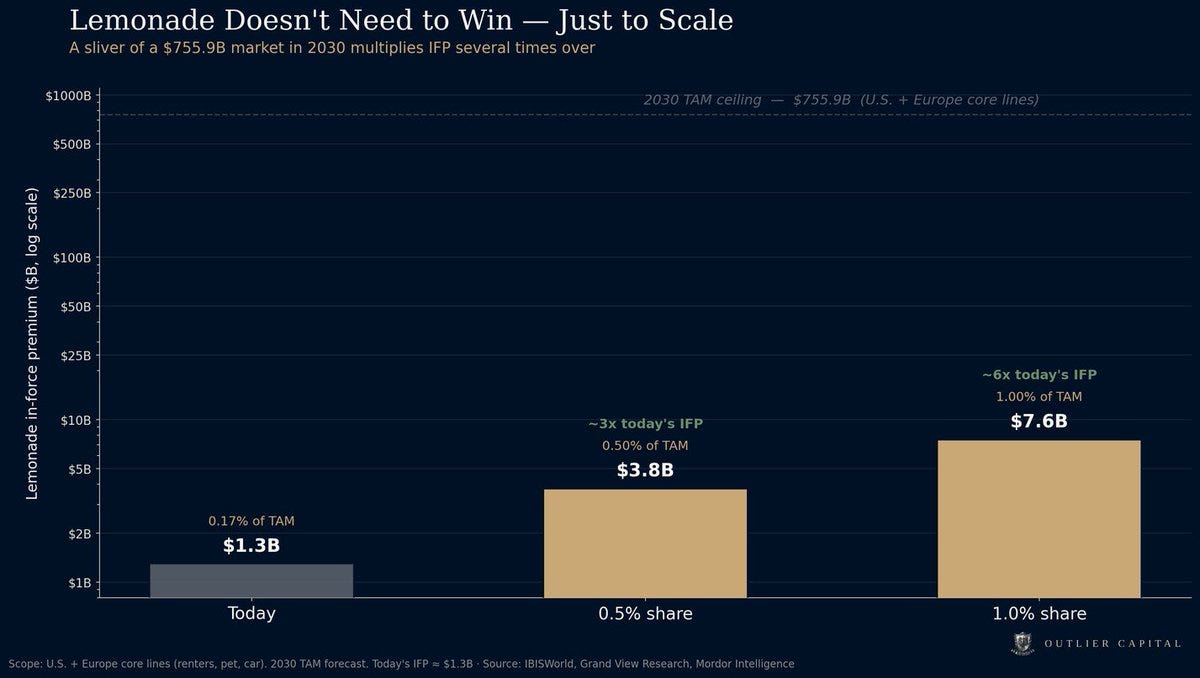
With LMND currently at 0.18% of market share of their core products in the US + Europe, assuming they could get to 0.5% would take them from 1.3B in IFP to about 3.8B of premium. And that is excluding life and home insurance and any new insurance lines they offer.
This is to show you that Lemonade just needs to continue scaling and taking a tiny bit of market share. Although they do things better than the rest of insurance companies, they don’t need to dominate the industry for it to grow a ton from here.
As you can see in the graphs above, car insurance is by far the largest insurance market, which Lemonade currently has a tiny market share of. They currently operate in only 10 states for car insurance, which leaves plenty of growth ahead of them as they expand into new states.
In Europe, they are currently live in 4 countries with plans to expand to Austria, Belgium, Bulgaria, Croatia, Czech Republic, Denmark, Estonia, Finland, Greece, Hungary, Ireland, Italy, Latvia, Liechtenstein, Lithuania, Luxembourg, Malta, Norway, Poland, Portugal, Republic of Cyprus, Romania, Slovakia, Slovenia, Spain, Sweden, and Switzerland.
Clearly, plenty of room to grow in Europe as well.
Growth
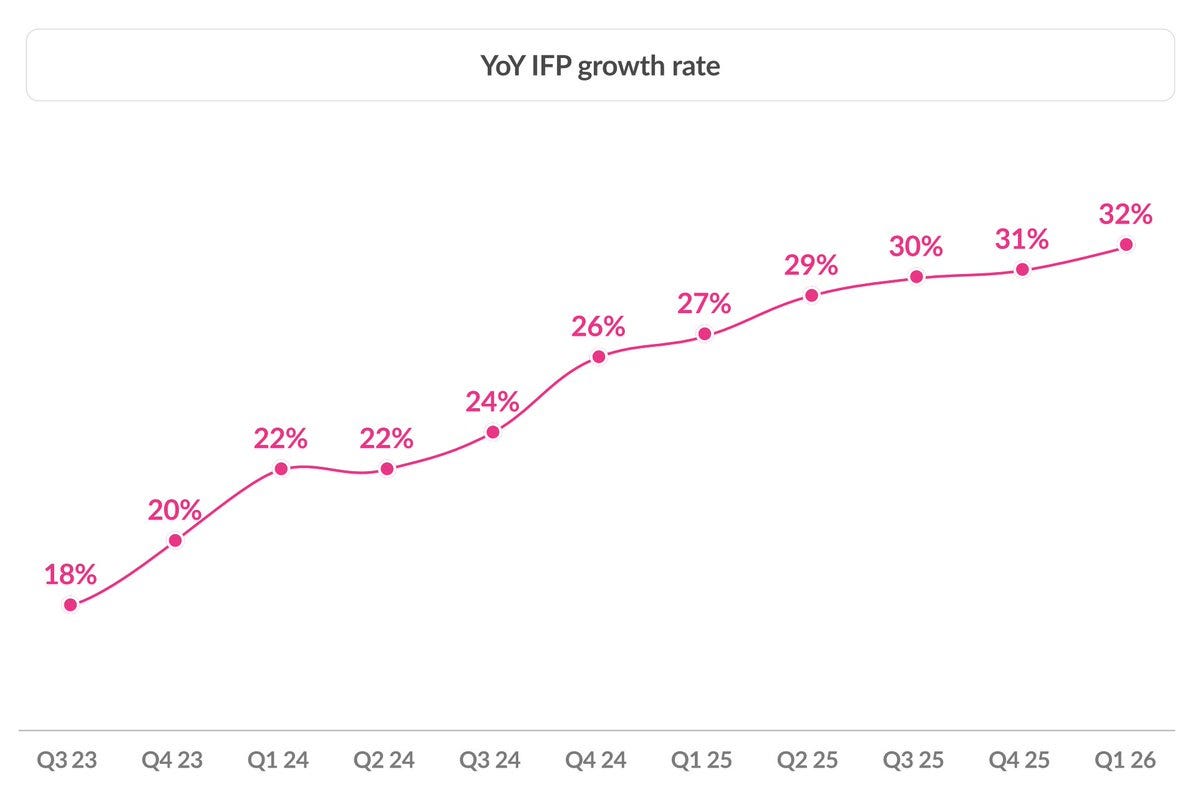
Lemonade has had 10 consecutive quarters of accelerating IFP growth (in force premium). An amazing achievement which I believe will be hard to continue, however I believe they can continue to compound growth at around 30% for a long, long time.
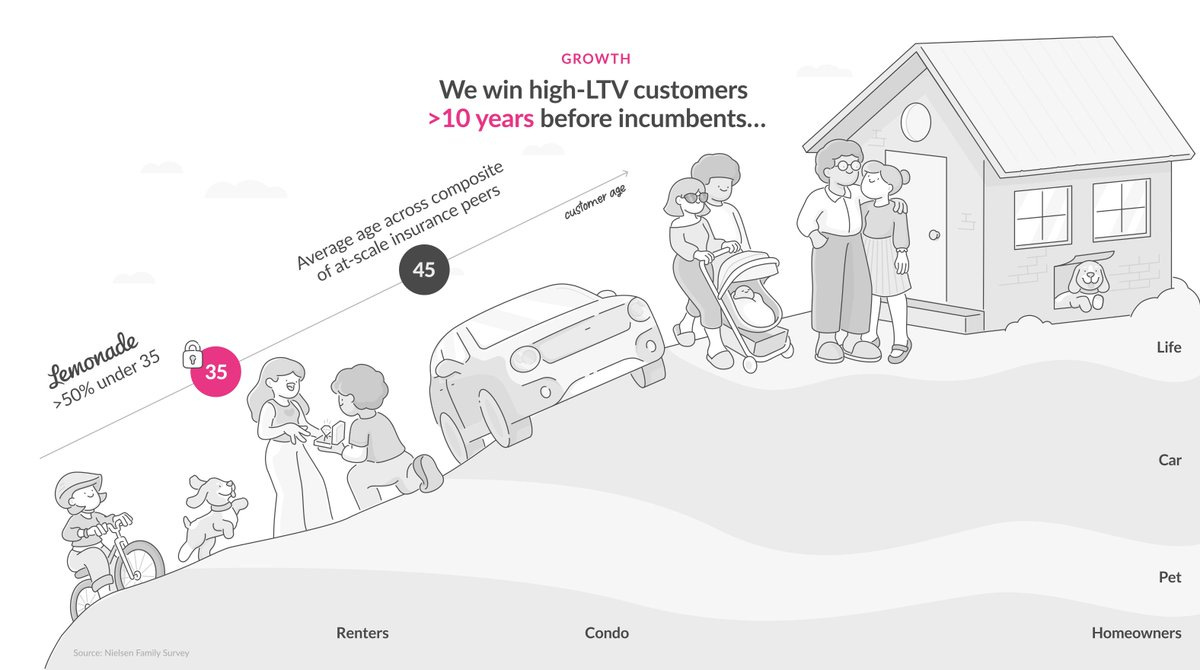
Part of the LMND thesis which management brilliantly thought of in the early days of the company, was to attract a younger customer base through renters and pet insurance, and as they got older and earned more income, they would add more policies such as car, home, and life.
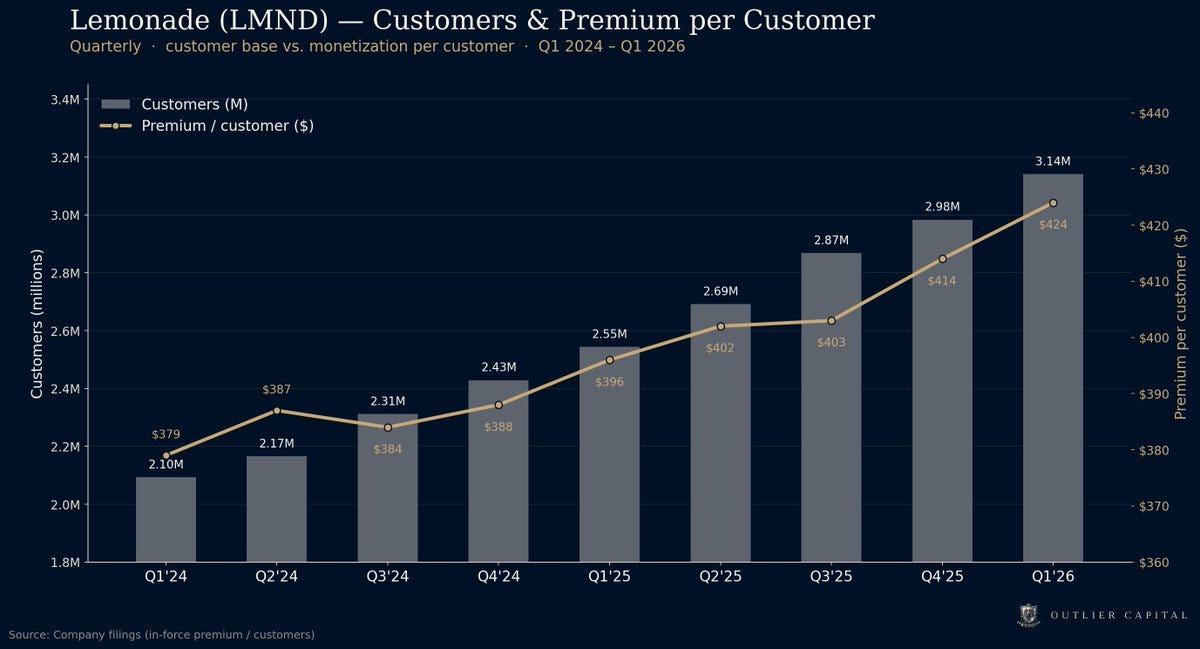
As they have grown customer count, they have gone from $379 of premium per customer in Q1’24 to $424 Q1’26. Showing that the thesis is playing out.
Why Incumbents Won’t Catch Up.
A common thing people say when they don’t understand Lemonade is “Why can’t they just slap on an LLM and use AI”
If you have ever seen what the inside of a century old Fortune 500 company looks like, then you’d know it looks like they are still operating in a completely different universe than the modern companies today.
They have bloat everywhere in the company. Tech debt. Using old systems that don’t work. You can’t just slap on an LLM and think that you will be anywhere near a company whose entire foundation is built on AI.
For these companies to become anything close to what Lemonade is, they would have to cut most of the company, rip out the old systems used, restructure and rebuild from the ground up. That’s not going to happen. And if it does, it would take a long time to rebuild.
I highly recommend reading Why Incumbents Won’t Catch Up by Daniel Schreiber, LMND CEO. It’s an excellent article where he goes into more detail on this subject.
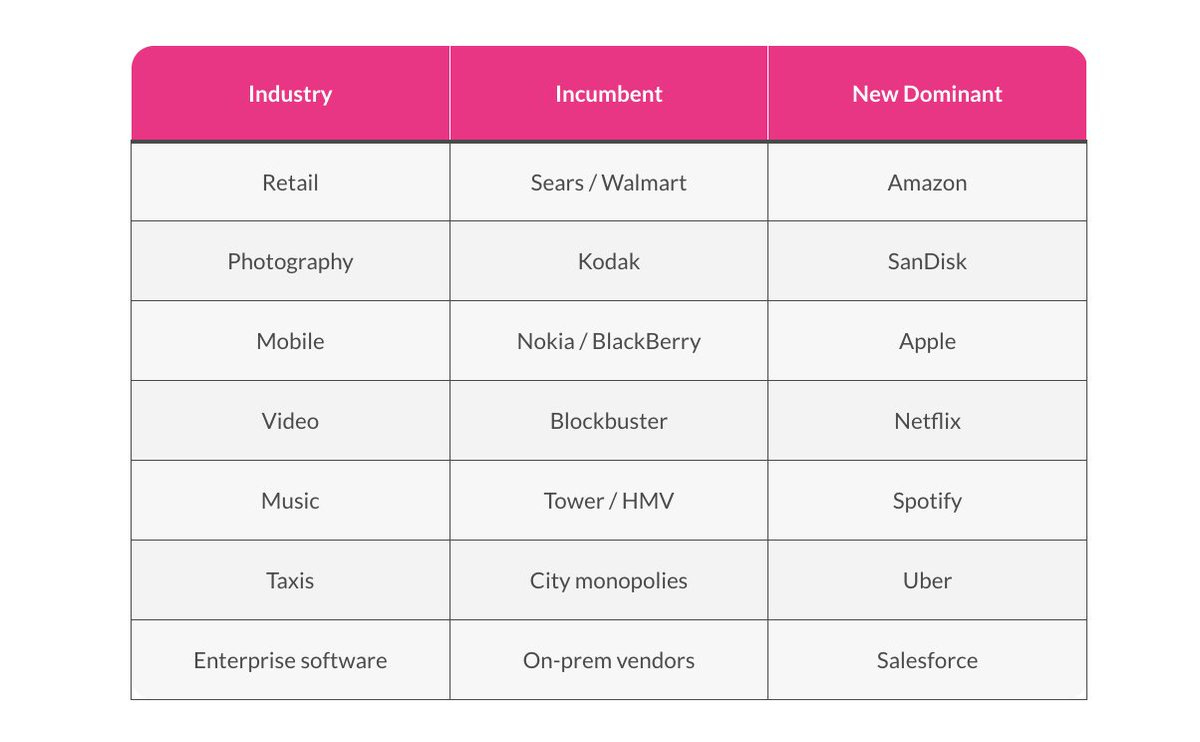
At Berkshire Hathaway’s annual meeting just about a month ago, Ajit Jain, who oversees Berkshire’s insurance operations, including GEICO, described their approach to AI as “wait and see.” The individual operations “dabble” with AI, he said, but there has been no “conscious big-time effort.”
So one of the largest insurance companies is saying they are dabbling with AI, and Lemonade has an 11 year head start building their foundation on it. They cannot simply become what Lemonade is.
That’s how disruption happens. The disruptor is ignored until it’s too late.
Gross Loss Ratio
Gross loss ratio (GLR) is just the percentage of premium an insurer pays back out in claims. Collect $100 in premium, pay out $70 in claims, and your gross loss ratio is 70%. Lower is better. It means you priced the risk well and you’re keeping more of every premium dollar. It’s the cleanest single measure of whether an insurance company actually knows how to underwrite.
This used to be the entire bear case on Lemonade. “They’re growing fast, but they’re a tech company playing insurance. Their loss ratios will blow up.” Bears assumed the AI-pricing story was marketing, and that real claims experience would expose them.
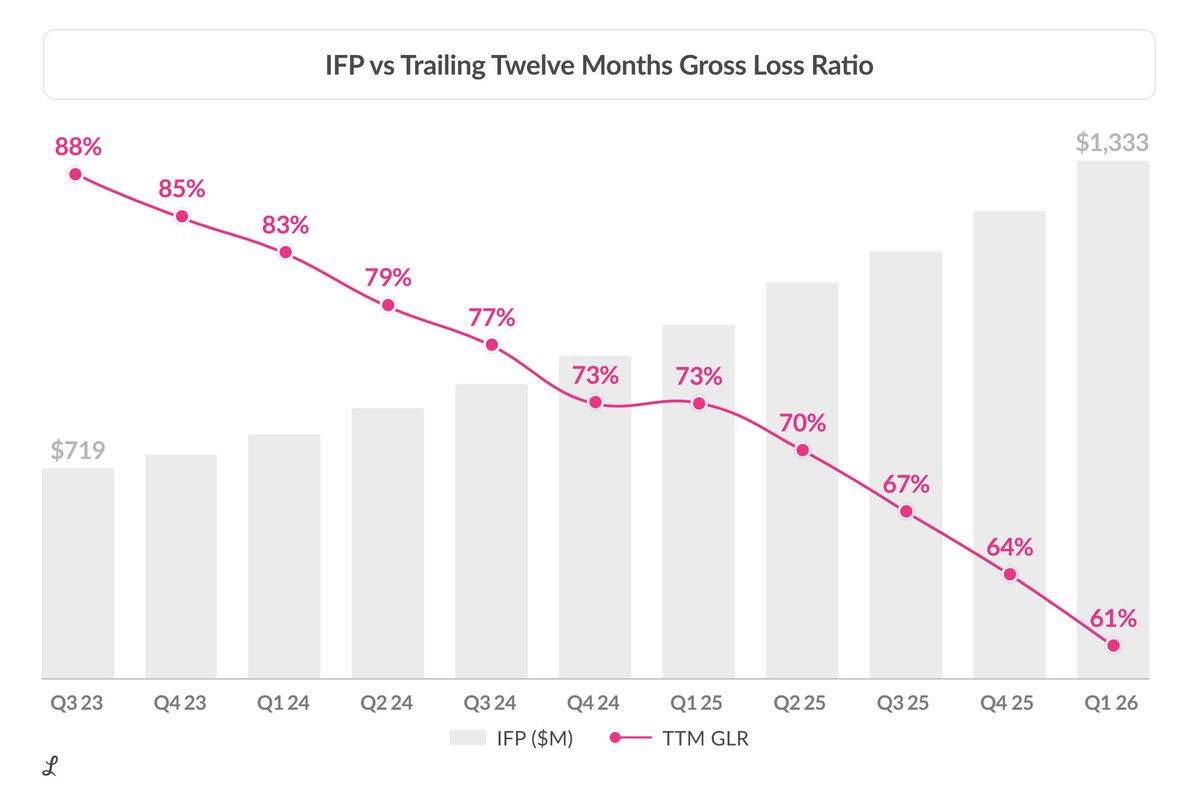
As you can see, they have done an excellent job of getting GLR down from 88% to 61%.
Management has said Gross Loss Ratio can be a lever they pull and they aim to have 70% as their max target. Right now they are sitting at 61%, meaning if they really want to fire up growth, they can lower pricing and go back up towards 70%, and give customers even better pricing than they already do.
Operating Leverage
This is what makes the Lemonade opportunity truly unique. Because insurance is just a promise and math. LMND’s operating expenses can stay relatively fixed as they scale, and more of the top line can go directly to the bottom line.
Legacy insurance companies such as State Farm, or Progressive, have variable costs that go up as they grow. They need more insurance agents, claims adjusters, underwriters, call centers, etc. Lemonade does not.
The true magic with Lemonade will be seen when they become profitable. Their profit will grow much faster than anyone has ever seen in insurance.
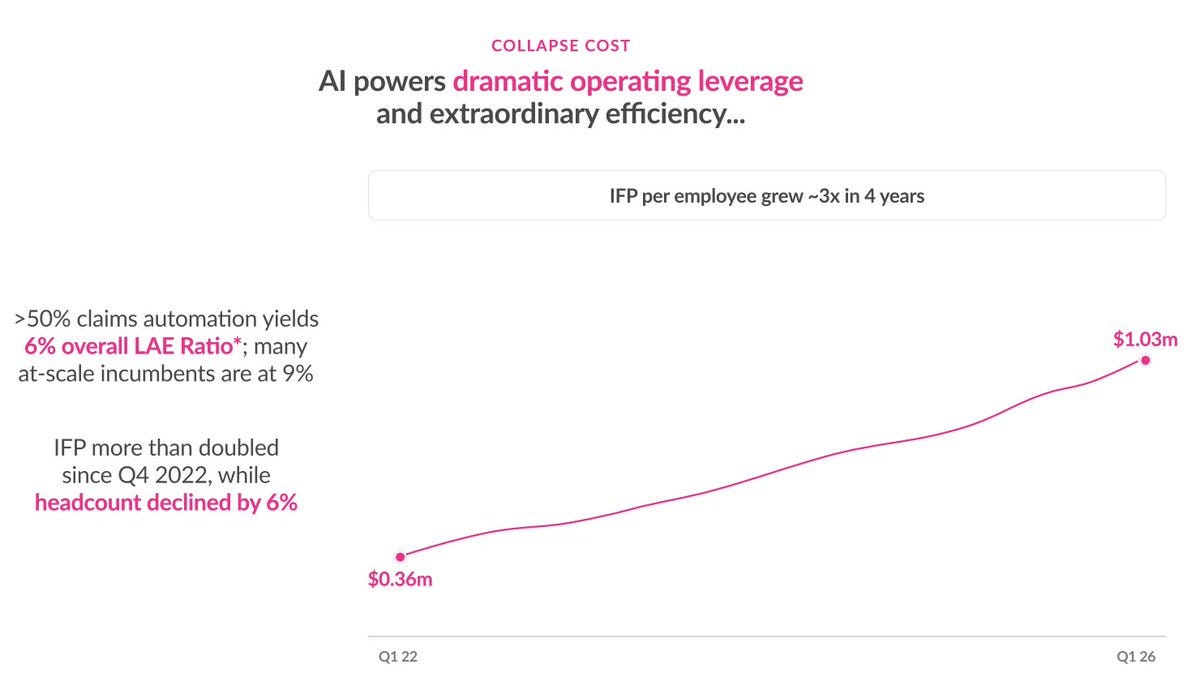
Since Q4 2022, LMND has doubled their In-force premium, and headcount declined 6%. This would be impossible for State Farm, Progressive and the like to achieve.
LMND now has gone from $0.36M in IFP/employee to now $1.03M with the goal of getting to $4M/employee and beyond.
Hidden Inflation and Recession Hedge
One of the many reasons why I really like LMND is due to the nature of their business being quite immune to macro forces. Their business can be resilient in inflationary or recessionary environments. There is even an argument that their business does even better in a recession, as more people look to save money on their insurance premiums and Lemonade being able to offer the best prices.
Insurance premiums rise with inflation as the cost of what they are insuring goes up. Unlike something like a restaurant, where margins get compressed/and or prices rise which can lower demand and slower growth, insurance is something that is pretty much necessary.
Valuation
LMND’s market cap is currently $3.95B
Trading at 4.68x sales, 3.28 forward
PGR (Progressive) $119B - 1.33x sales, 1.35 forward
KNSL (Kinsale) $7.1B - 3.68x sales, 3.69 forward
Kinsale was included to show what a multiple for a more profitable insurance company can look like. They are a specialty insurer with higher margins. Their business model isn’t the same, but the aspect of higher profitability earning a higher multiple shows what that would look like.
So if you compare LMND to PGR it looks expensive. On a TTM basis, compared to KNSL, it’s more expensive, but fwd p/s is cheaper.
Depending on how you look at it, some may say this is expensive for LMND, however I believe it is too cheap.
Why? Growth.
As of Q1 2026, PGR grew top line 8.7%, and KNSL grew 10.2%
LMND grew 71%, and grew IFP at 32%
The gap in revenue growth to IFP growth is due to a reinsurance change they made recently, now that they achieved the scale to keep more of the premium, where previously they were ceding more premium to reinsurers. Eventually revenue growth and IFP growth will converge, but still. IFP growth is at 32%.
Both Progressive and Kinsale have decelerating growth, while LMND’s is accelerating. If you look at FWD P/S, both PGR and KNSL have higher forward multiples than trailing, where LMND’s is much lower.
So when considering LMND’s growth, TAM, and operating leverage, I’d argue that the multiples LMND is trading at is actually cheap. It shouldn’t be the same multiple as a $119B dinosaur that’s barely growing. It should be much higher.
Risk/Bear Case
I constantly search for bear cases, however I struggle to find any that are compelling these days. These are the last standing bear cases, as many of the previous ones when LMND was much younger have been eliminated.
Bear Case #1 - They’re Unprofitable
This is an extremely lazy one, yet it’s the most common I see these days. A long/short fund pulls up the screen, sees a net loss, and slots it into the short book without putting any effort into understanding the company.
Every profitable company was once unprofitable. The real question isn’t “are they profitable today,” it’s “is there a clear path to profitability, and is the unit economics trend pointing the right way.” For Lemonade the answer is yes on both: loss ratios are improving as they scale, operating expenses are staying roughly flat while premium compounds, and management has guided to adjusted-EBITDA profitability for FY 27 and GAAP profitability following shortly after.
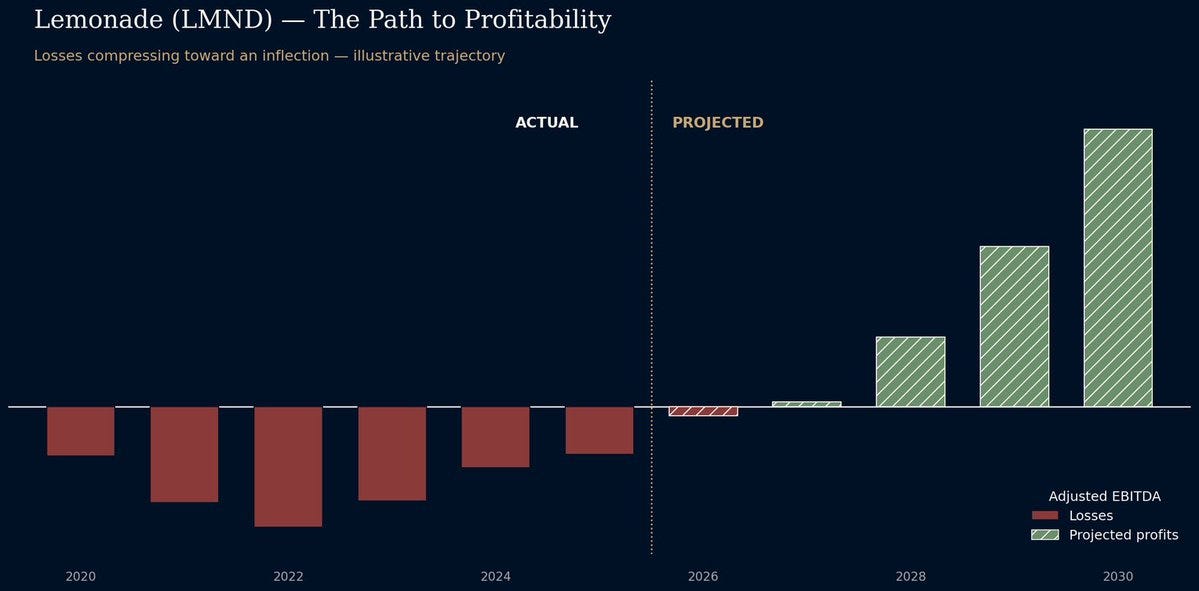
This would be a legitimate bear case if you valued stocks on the past, not the future. The chart above is roughly what I believe LMND’s profitability is going to look like in the future.
Bear Case #2 - Valuation
I detailed this in the valuation section, however this is the most legitimate bear case. In an irrational market, a “cheap” disruptor can always get cheaper. Multiples compress, disruptors get mislabeled as overvalued by people anchoring to legacy comps, and you can sit underwater for a while even when you’re right. That’s a real risk to the stock, not the business.
A valuation compression further than what has already occurred would simply present an even better buying opportunity ahead of profitability in my opinion.
Bear Case #3 - Dilution
This is not a bear case in my opinion. It’s something to account for when modeling the numbers but does not break the thesis at all even though bears would like to say it’s a bear case.
Bear Case #4 - Catastrophic Event
Being an insurance company this will always be a risk. A bad hurricane, wildfire, etc could spike claims and create a bad quarter but this would just be short-term volatility risk, not a thesis-breaking risk. LMND still has reinsurance to cap their exposure and to make sure they are solvent in the case of such an event.
Price Target
This is my back of the napkin price target for LMND in 2030:
I think they can do around $3.5B in revenue for FY 2030. Which assumes they compound 30% off of 2027 estimates (which I expect them to beat). This is very achievable.
Applying KNSL multiple of 3.68x sales would bring it to a $12.88B market cap.
At the same P/S LMND is trading at now, the market cap would be roughly $16B
In 2030, the operating leverage will be kicking in and the exponential curve of profitability will be happening, deserving them a premium multiple as they continue to have strong growth, so there is an argument for 5-6x sales.
The point of this is not to nail exactly what the price will be, but just to be directionally correct. This is just a ballpark. The point is to show the asymmetry and opportunity ahead.
I know some LMND bulls may say I am being too conservative, and the bears will say I am too aggressive and it should trade the same as PGR, however I do believe I am being somewhat conservative here. There is the real possibility that they have stronger growth and/or have a multiple re-rating post-profitability, similar to what happens with many disruptors when the market realizes it.
With that being considered and accounting for some dilution, my rough 2030 price targets are:
$140 bear, $200 base, $250 bull (current price $51.46)
Zoom Out
Zoom Out.
The stock will move around in the short term. That is unavoidable.
The market will react to quarterly loss ratios, catastrophe headlines, dilution fears, profitability timing, growth deceleration, and whatever multiple investors are willing to pay for unprofitable growth at that moment.
But if the company keeps executing like they have been consistently, I think the asymmetry is still very attractive and the company will look very different in 2030 than it does today.
Contact
If you are an accredited investor and want to learn more about Outlier Capital, please reach out to my email: matt@outliercapitalmanagement.com or the contact form at outliercapitalmanagement.com
Disclaimer
The content in this article is for informational and educational purposes only. It reflects my personal opinions and analysis as of the date of publication, and it is not investment advice, a recommendation, or a solicitation to buy or sell any security. Nothing here is tailored to your individual financial situation, objectives, or risk tolerance. Do your own research and consult a licensed financial advisor before making any investment decision.
I, and/or Outlier Capital and its affiliates, may hold a position in the securities mentioned, including LMND, and may buy or sell at any time without notice. I have no obligation to update this article if my views or positions change.
This article contains forward-looking statements, estimates, and projections — including revenue forecasts, market-share assumptions, and price targets. These are inherently uncertain, rely on assumptions that may prove incorrect, and are not guarantees of future performance. Actual results may differ materially. Price targets are illustrative “back-of-the-napkin” scenarios meant to frame potential outcomes, not precise predictions.
Information herein is drawn from sources I believe to be reliable, including company filings and public data, but I make no representation or warranty as to its accuracy or completeness. Figures may contain errors or become outdated.
Investing involves risk, including the possible loss of principal. Past performance is not indicative of future results. You are solely responsible for your own investment decisions.
This communication is not an offer to sell or a solicitation of an offer to buy any interest in any fund managed by Outlier Capital. Any such offer would be made only to qualified investors through formal offering documents containing complete terms and risk disclosures.