



Bank OZK is known in commercial real estate circles as one of the country’s most aggressive and concentrated large-project lenders. Its Real Estate Specialties Group finances construction and transitional projects whose repayment depends on successful lease-ups, sales or long-term refinancing. The size and concentration of those loans made OZK look exceptional during the boom. They now make individual project failures capable of moving the bank’s quarterly earnings.
A large part of the remaining loan book was underwritten when interest rates were much lower and developers expected higher rents and property values at completion. Those projects now face the opposite environment. Yields remain elevated for far longer than anticipated by the entire commercial real estate industry and the labor market continues to get weaker and weaker.
The market has been under stress for years. OZK and its borrowers responded by extending maturities, adding owner-funded reserves and waiting for lower rates, stronger rents and a better transaction market. Those conditions have failed to arrive. Several owners have stopped putting in money, potential buyers have failed to close and estimated property values have moved closer to the amount OZK is owed. Loans have stopped paying normally, the bank has taken ownership of more properties and losses have followed.
Management says the bank is late in a long property downturn and expects a few more problem projects over the next 12 to 18 months. OZK has described the cycle as being near its end for years. My view is that the repeated extensions are finally reaching their limit. The weakest projects now need real buyers or long-term lenders before owner support and property values give way.
How the Can-Kicking Works:
OZK finances a large construction or transitional project.
The project misses its original leasing, sale or refinancing timeline.
The owner contributes more cash to cover interest and operating costs.
OZK extends the maturity and may reduce the amount it still promises to lend.
The loan continues paying while the owner searches for tenants, a buyer or a long-term lender.
If the owner stops contributing before the project finds an exit, the loan stops paying normally, the bank may take the property and losses can follow.
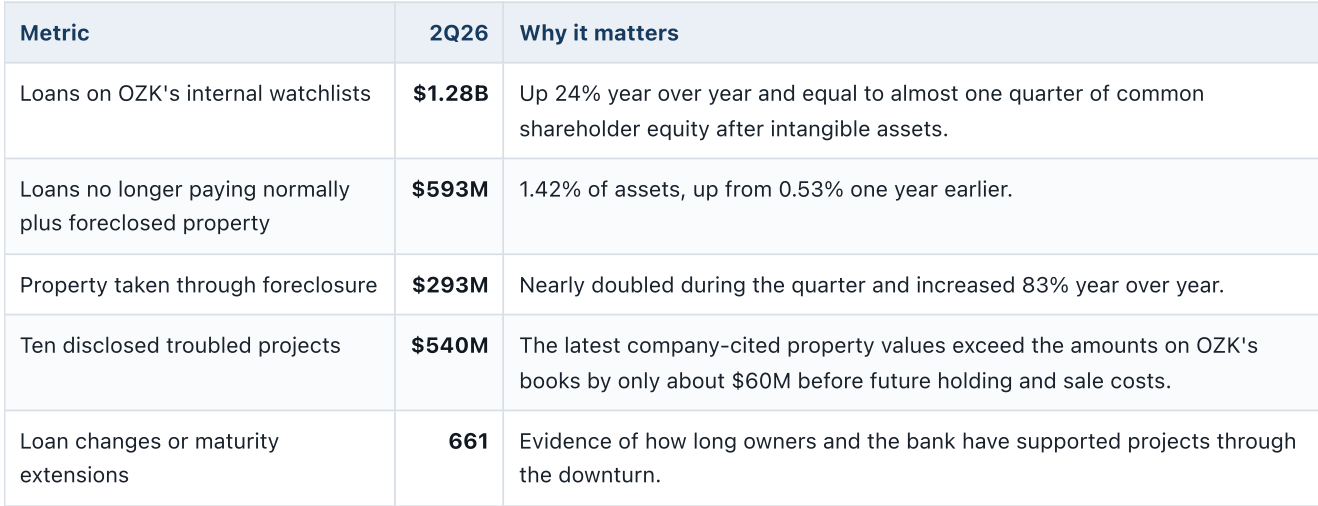
Over 16 quarters, project owners and their partners provided approximately $1.4 billion of additional support. That included $923 million set aside to pay interest and operating costs and $522 million of early repayments. During 2Q alone, owners made $91.5 million of early repayments and set aside another $19.5 million.
The question is how long owners can keep funding projects that have already missed their original plans. OZK has called the downturn late-stage for years, yet 37 more loans were changed in 2Q. With 243 current large property loans, those changes equal 15% of the current loan count. The cumulative 661 includes loans that have repaid, but it still shows how often the original timeline failed.
The strategy depends on time eventually producing better economics. Interest rates remain high, rents and tenant demand have weakened in the most troubled markets, and transaction activity remains thin. At some point, people run out of money to keep these assets alive. That point has already arrived for several projects now sitting in foreclosure or on the bank’s problem-loan list.
Giving a healthy project more time can work. Trouble starts when every delay requires more money from the owner and still leaves the project without a buyer or long-term lender. Eventually the owner stops paying to wait.
Five Numbers That Matter
The Final Stage is Becoming Visible
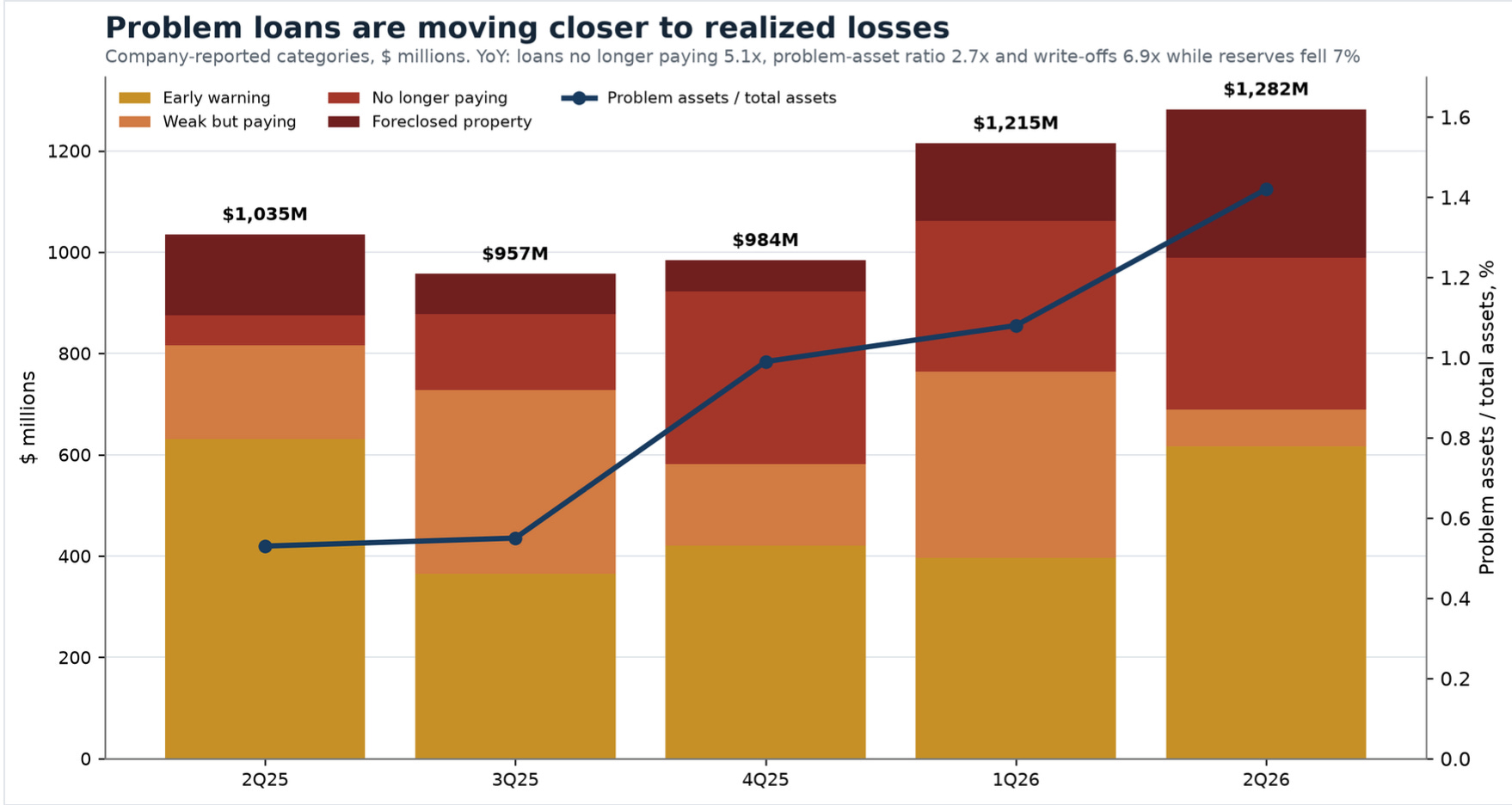
The reported numbers have moved from early warnings into realized losses:
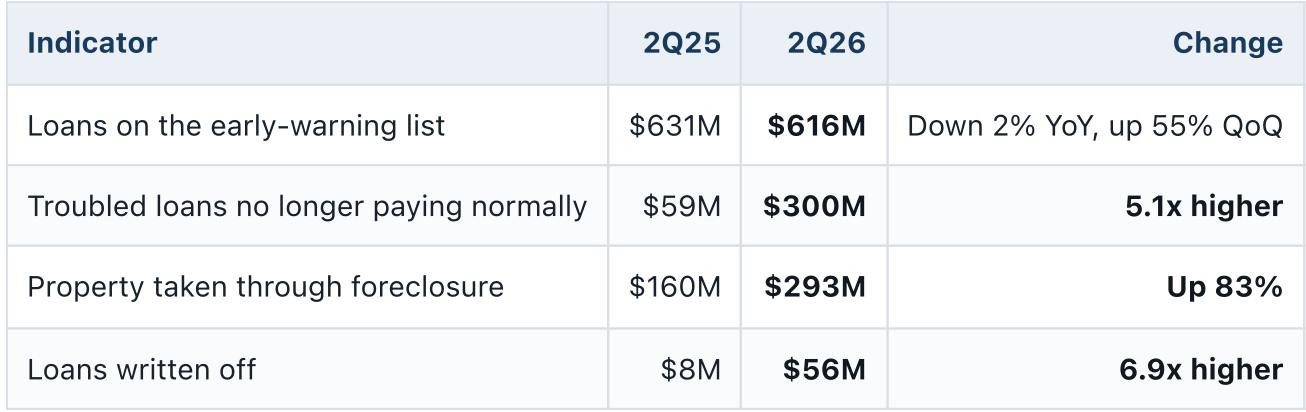
OZK wrote off $49.3 million on four office and life-science loans during 2Q. Project owners had stopped contributing to the San Carlos life-science project and the Atlanta office. Buyers withdrew from the Seattle office and life-science transactions before the bank took ownership.
Management expects several loans on its early-warning list to return to normal after extensions or new owner funding are completed. The same group could produce the next troubled loans if the deals fail to close or owners stop contributing.
The bank is already losing money on some projects. The remaining question is how many additional large projects follow the same path.
How OZK Reports the Deterioration
These are the company’s formal categories. They are stages in one continuous process.
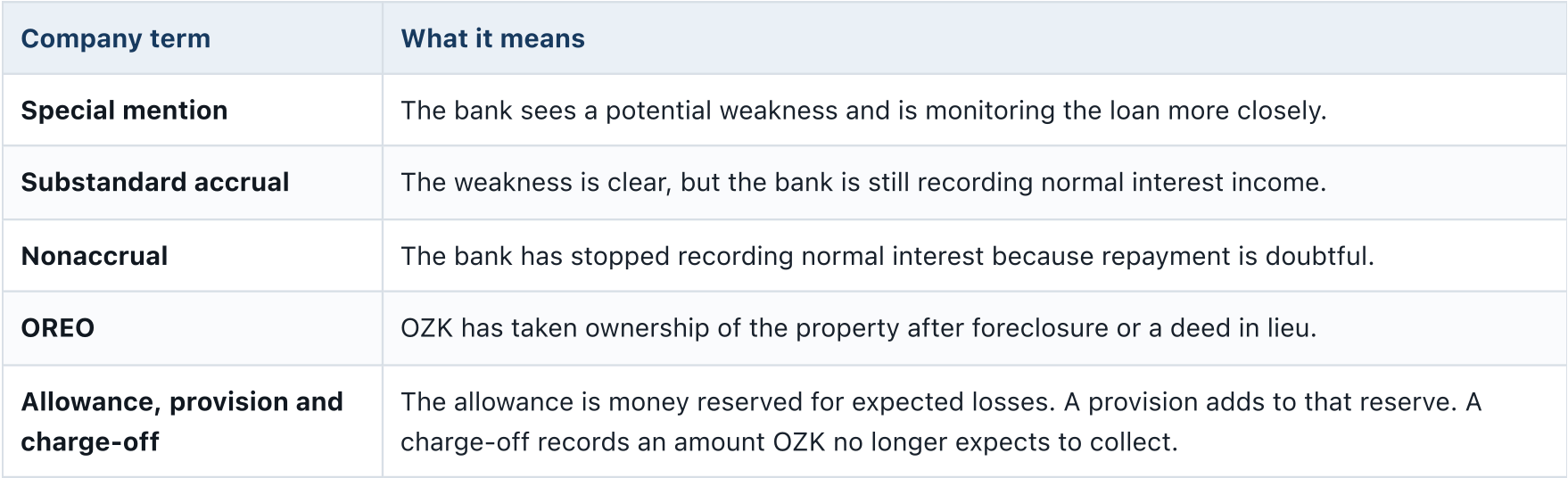
Detailed Movement Through the Categories
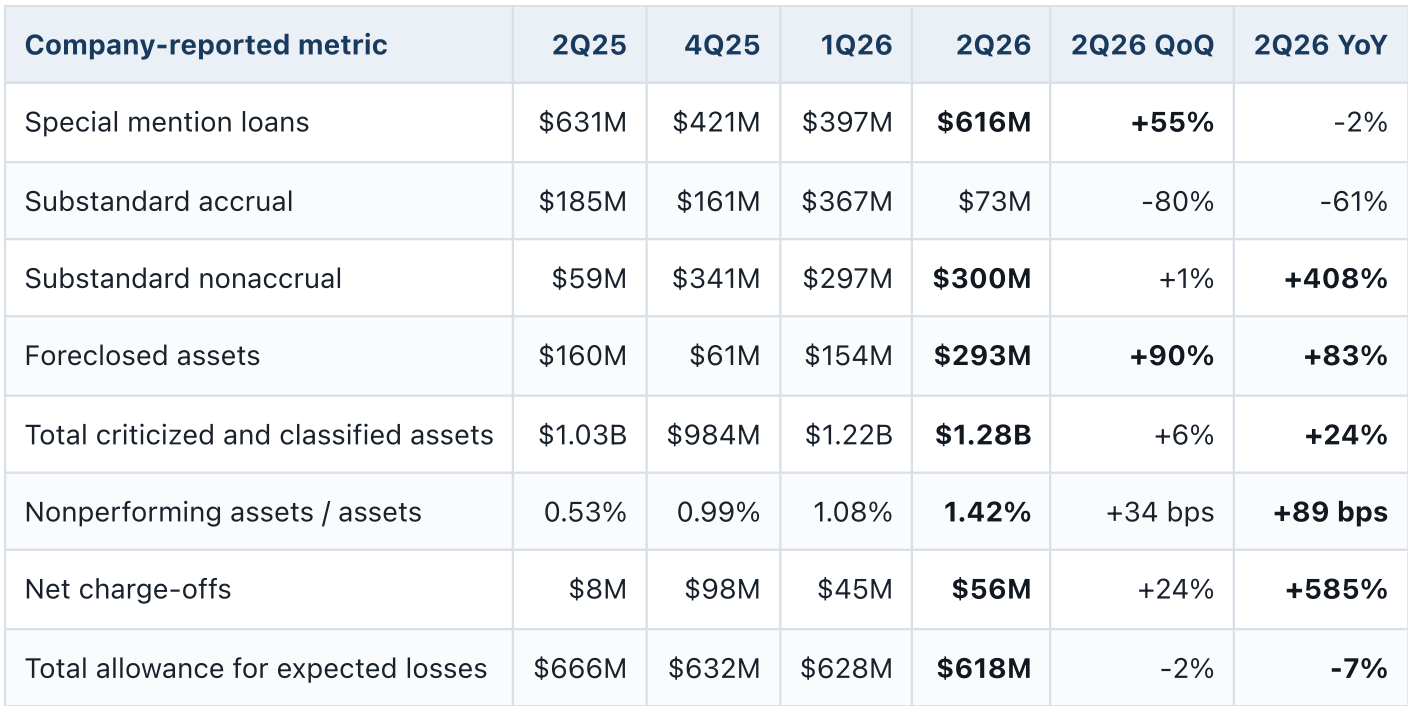
Management said the Seattle office and life-science losses had been substantially reserved in prior quarters. It expects the allowance to drift lower if the economy remains resilient and believes the remaining reserve is adequate. That view is questionable in my opinion.
Four Projects Show the Progression
The four examples below are best understood as different stages of one process.
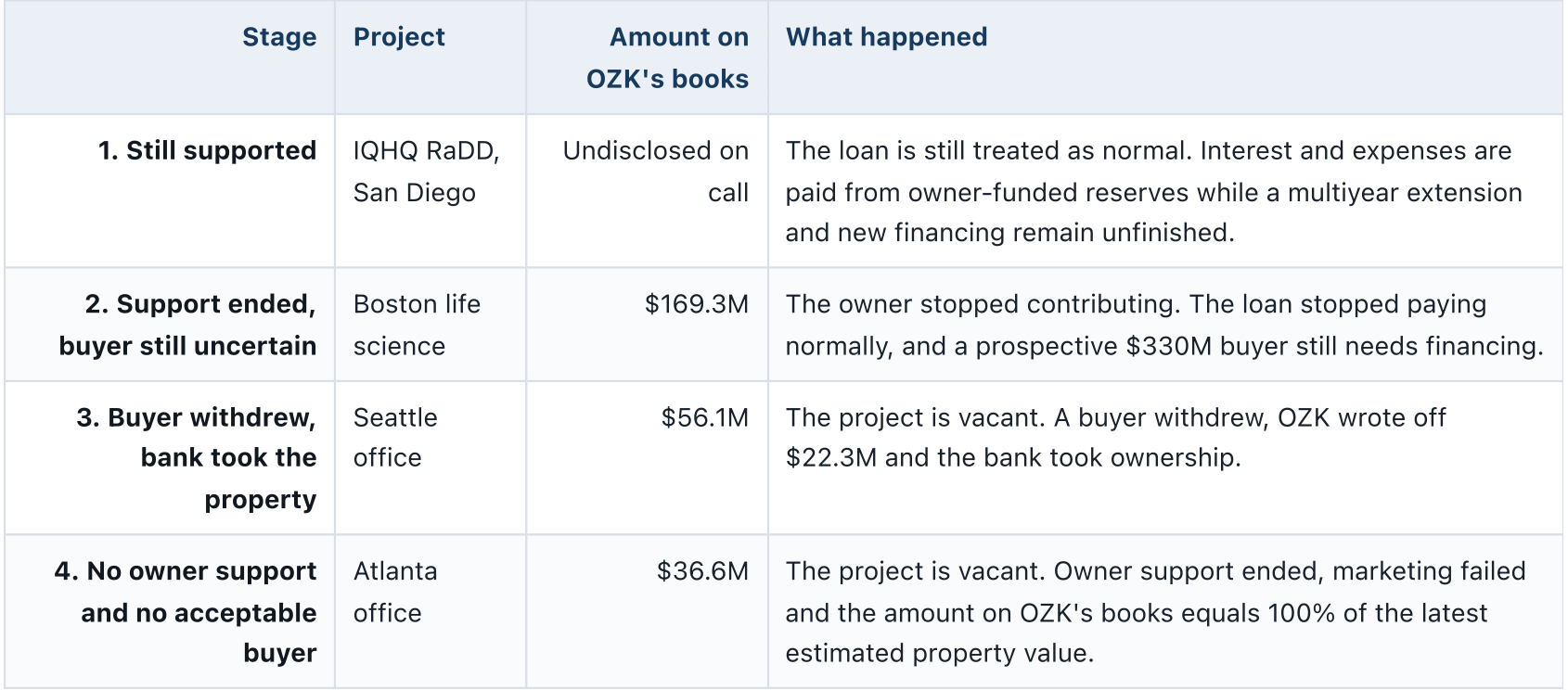
IQHQ is the clearest current test of whether the extension strategy still works. OZK, the project owner and a junior lender are negotiating a multiyear extension and new financing. Management expects a successful outcome and continues to treat the loan as normal because the talks are constructive. The final terms, new owner contribution and amount of cash left to pay expenses remain undisclosed.
The progression is the core of the short thesis. IQHQ remains alive because reserves are paying the bills. Boston shows what happens when the owner stops contributing. Seattle shows what happens when a planned buyer walks away. Atlanta shows the end state when the bank owns a vacant property and has almost no room between its book value and the latest estimate of what the building is worth.
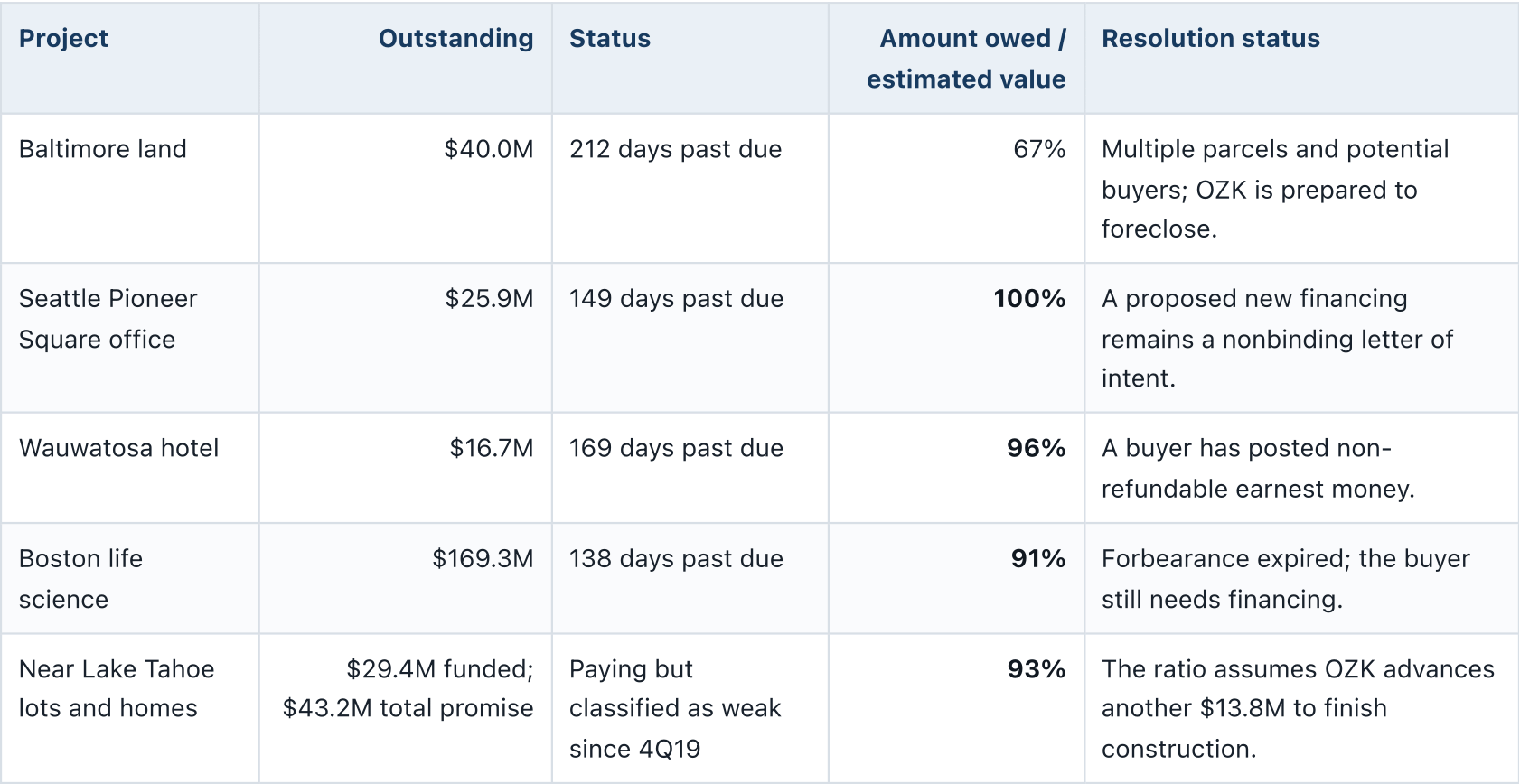
Other Disclosed Troubled Loans
Properties OZK has Already Taken
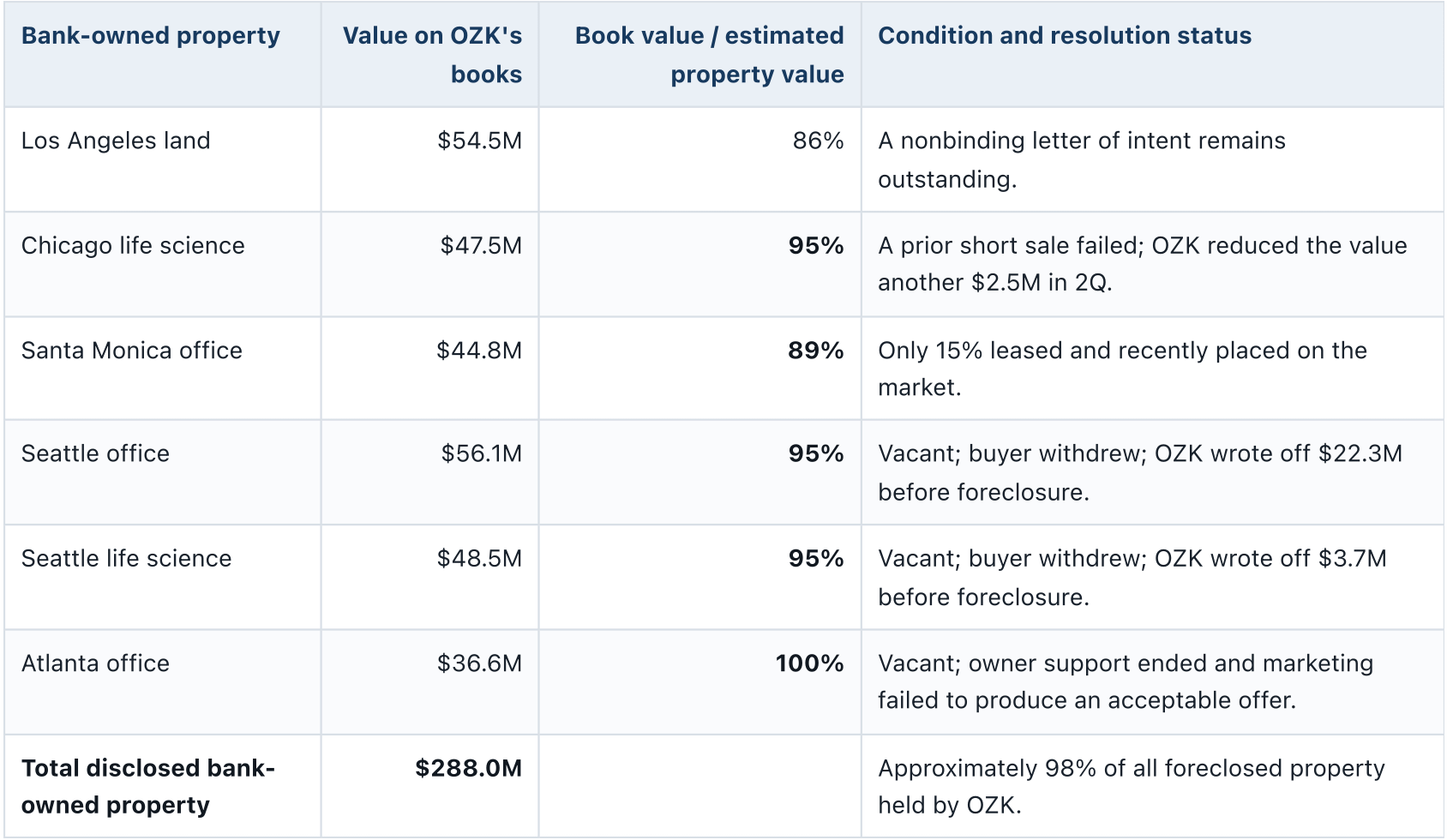
When OZK takes a property, accounting rules require it to use the lower of the loan balance or estimated value after selling costs. Any further deterioration requires another write-down. A 20% decline in the value of all bank-owned property would equal approximately $59 million before tax, or $0.42 per share after tax. The reality is some of these properties could be worth half or even worse as many CRE properties (especially office) have been going for pennies on the dollar.
The Reported Values May be Way Too High
The ten disclosed troubled projects total approximately $540 million on OZK’s books. The latest company-cited property values total approximately $600 million, leaving an apparent gap of only $60 million
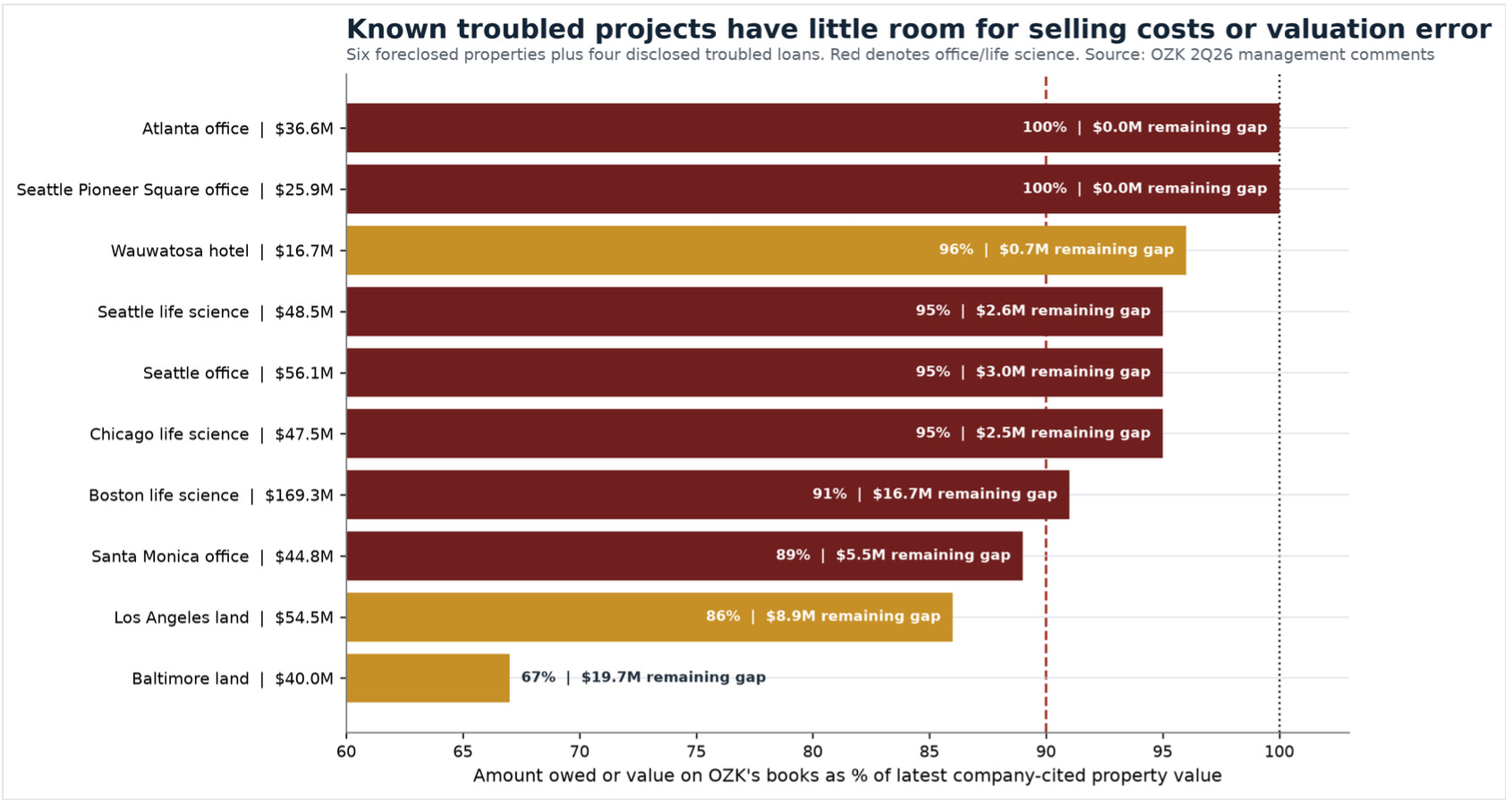
The chart shows why the reported gap offers little comfort. Nine of the ten projects are recorded at 86% or more of the latest estimated property value. Six are recorded at 95% or more. Atlanta and Seattle Pioneer Square are recorded at 100%.
Those estimated values are appraisals, not completed sale prices. The current market has already produced vacant properties, failed sales, withdrawn buyers and owners who stopped funding projects. Higher financing costs and lower rent assumptions reduce what a buyer can pay. The likelihood that every troubled property can be sold near 90% to 100% of its cited value is low.
If the appraisals are too high, the loss can be far larger than the reported $60 million gap suggests.
Concentration Risk
Management emphasizes that its average property loan equals only 46% of the project’s estimated value. That figure covers the entire portfolio and assumes every loan is fully funded. The troubled projects look very different:
Healthy projects are often measured using their expected value after completion and leasing, while troubled projects rely on their value today.
Transaction costs and future holding costs can consume the remaining gap.
One $147 million condo loan moved from 90.4% to 105.6% of estimated property value after a new appraisal.
Large successful loans pull down the average and hide what can happen inside a few failures.
The portfolio also contains unusually large individual loans.
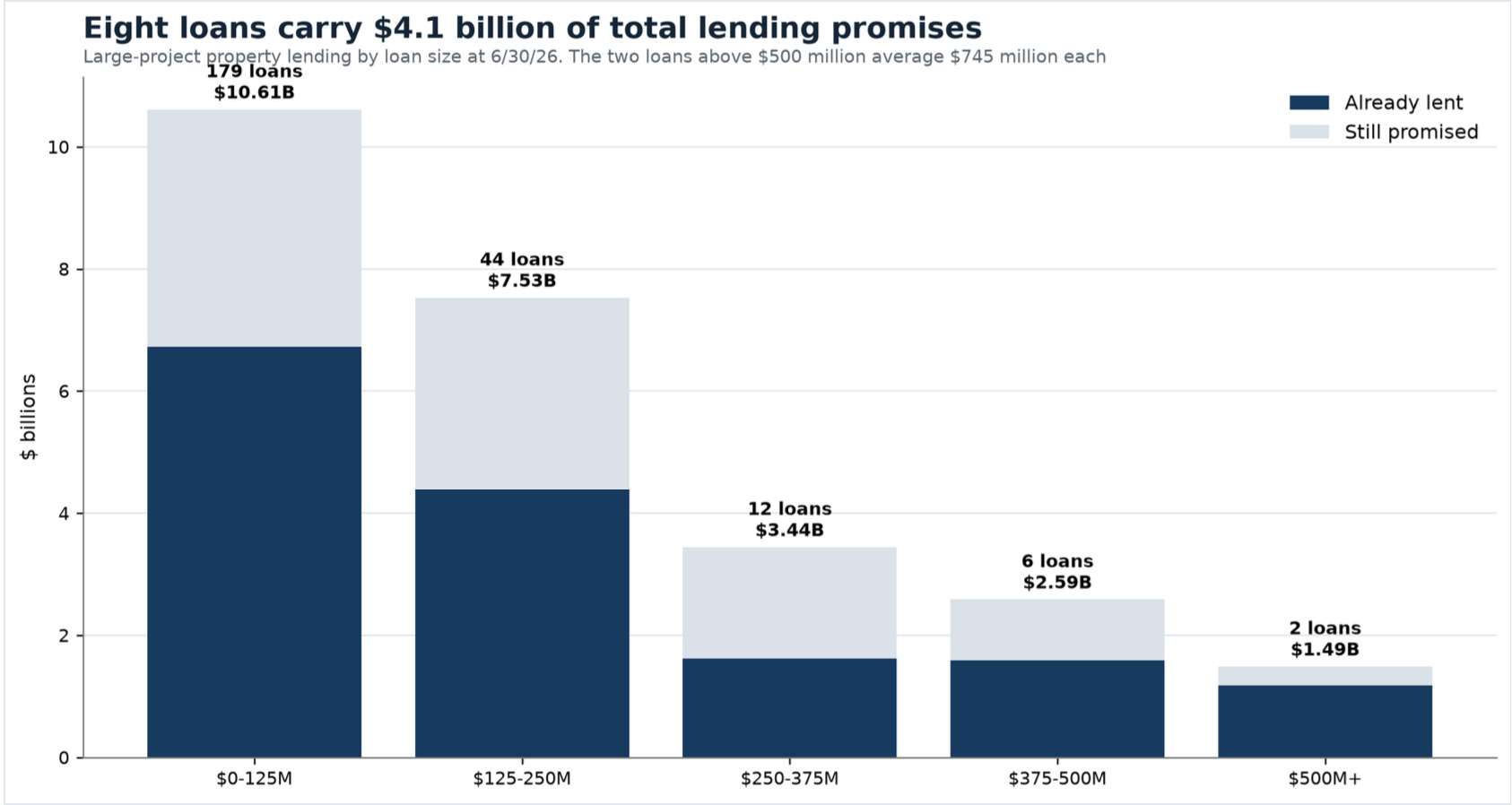
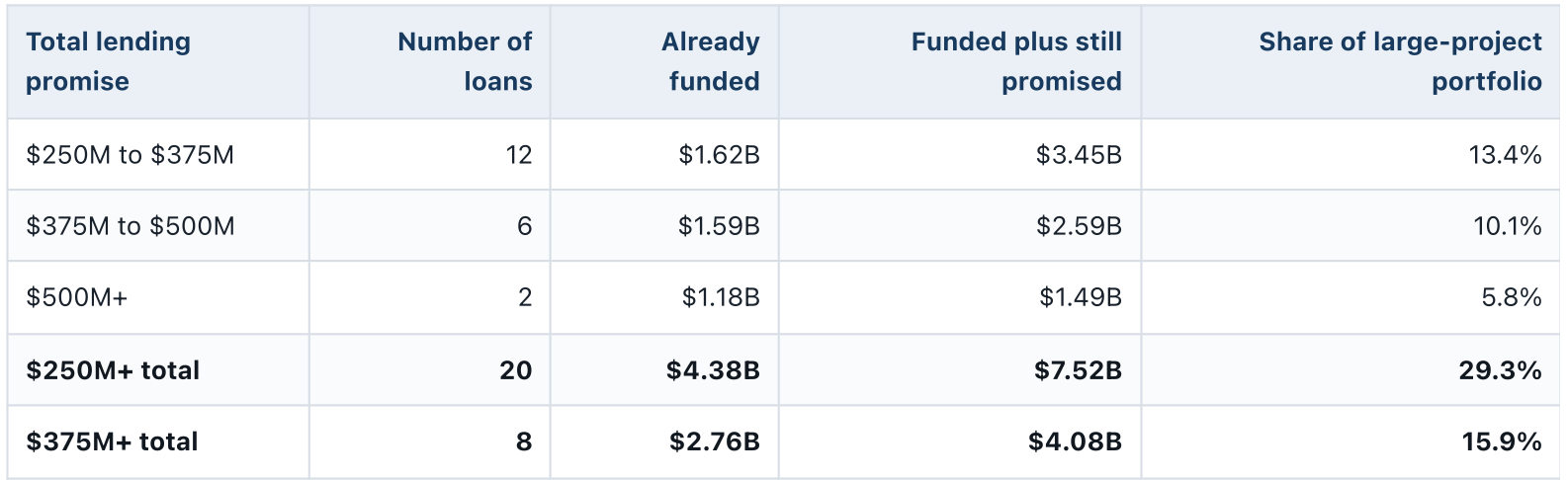
Twenty loans of at least $250 million represent $7.52 billion, or 29.3% of OZK’s total large-project lending promises. Eight loans of at least $375 million represent $4.08 billion. A 10% loss on one average $500 million-plus loan would equal approximately $75 million before tax, or roughly $0.53 per share after tax.
A healthy average across all loans can hide a few large and dangerous projects. Because these loans are so large, one or two setbacks can materially change quarterly earnings.
Large-Loan Concentration
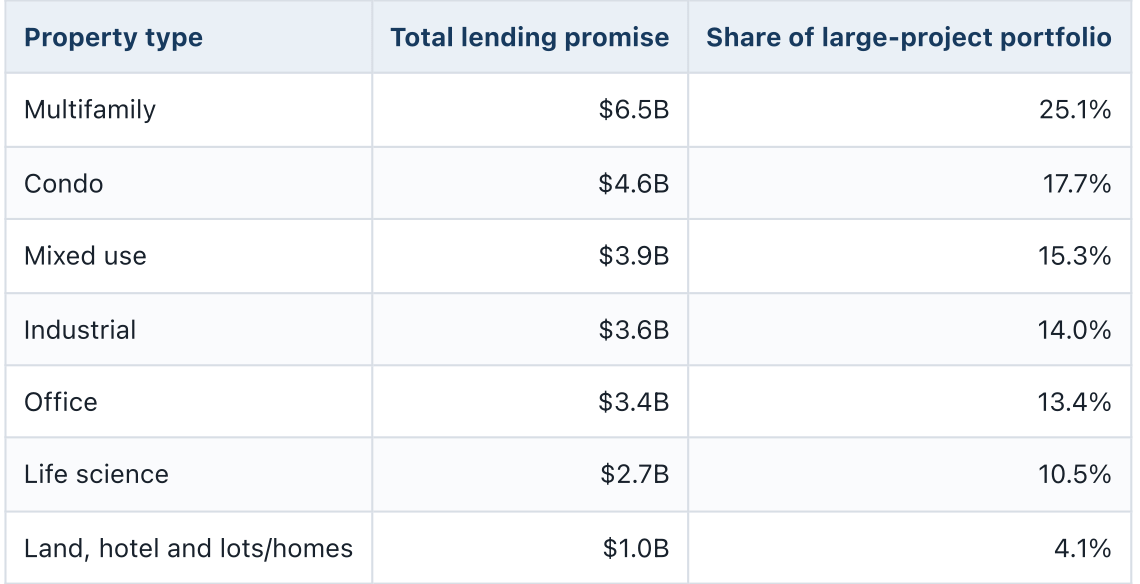
Property Mix
Repayments Reduce Risk and Pressure Earnings
The strongest bull argument is that OZK’s large-project property loans are shrinking quickly:
Repayments were $2.92 billion in 2Q and $9.95 billion over the last four quarters.
Funded large-project property loans declined to approximately $15.5 billion, or 47.6% of total loans.
Management expects repayments to remain elevated through 2027.
OZK expects its newer corporate banking business and large-project property business to become approximately equal in size during 2027.
The newer corporate banking business is a credible source of growth. It spans more than seven business lines and 42 industries. Management said the interest margin on new corporate loans exceeded the older corporate loan book by more than one quarter of a percentage point in 2Q. These relationships also bring deposits and fees.
The transition still creates an earnings gap. Total loans fell $414 million in 2Q despite rapid corporate-loan growth. Earnings before setting aside money for loan losses declined 5.6% year over year, operating expenses increased 11.4% and management now considers exceeding 2025 interest income a stretch goal. The cost of attracting deposits has likely passed its low point.
Rapid repayments lower the bank’s future property risk, but they also remove interest income. The new corporate business needs to replace that income before the old property loans create more losses.
Valuation and Price Target
What Could Prove the Short Wrong
The thesis would weaken materially if the next two quarters produce the following sequence:
Boston’s buyer obtains financing and closes.
Seattle Pioneer Square receives new owner funding and resumes normal payments.
Wauwatosa and Los Angeles sell near the values on OZK’s books after transaction costs.
IQHQ completes a well-capitalized extension that reduces OZK’s risk.
Improvements materially exceed new problems among loans on the early-warning list.
Corporate banking replaces the income lost as property loans repay.
Troubled loans and bank-owned properties decline through completed sales and long-term refinancing.
OZK has shown that favorable outcomes are possible. Its largest troubled loan in 1Q26, totaling $156.4million, returned to normal after the owner brought in new financing during 2Q. Similar outcomes across the remaining projects would challenge the short.
Near-term Tests
1. IQHQ’s August maturity: Final extension terms, new owner capital and the amount of cash left to pay expenses.
2. 3Q project resolutions:Management expects progress on one bank-owned property and three troubled loans.
3. Early-warning loans: Completed improvements versus new problems within the $616 million pool.
4. Realized sale prices: Cash proceeds after transaction costs versus the values on OZK’s books.
5. Earnings replacement: Corporate-loan growth, deposit costs and underlying profit trends.
Conclusion
For years, OZK and its borrowers waited for lower rates, higher rents and a stronger transaction market. Those conditions have failed to arrive. The 10-year Treasury has matched its 2026 high, hiring has slowed, buyers remain scarce and several owners have stopped contributing. The remaining extensions are approaching the point where the projects must sell, find long-term financing or produce losses.
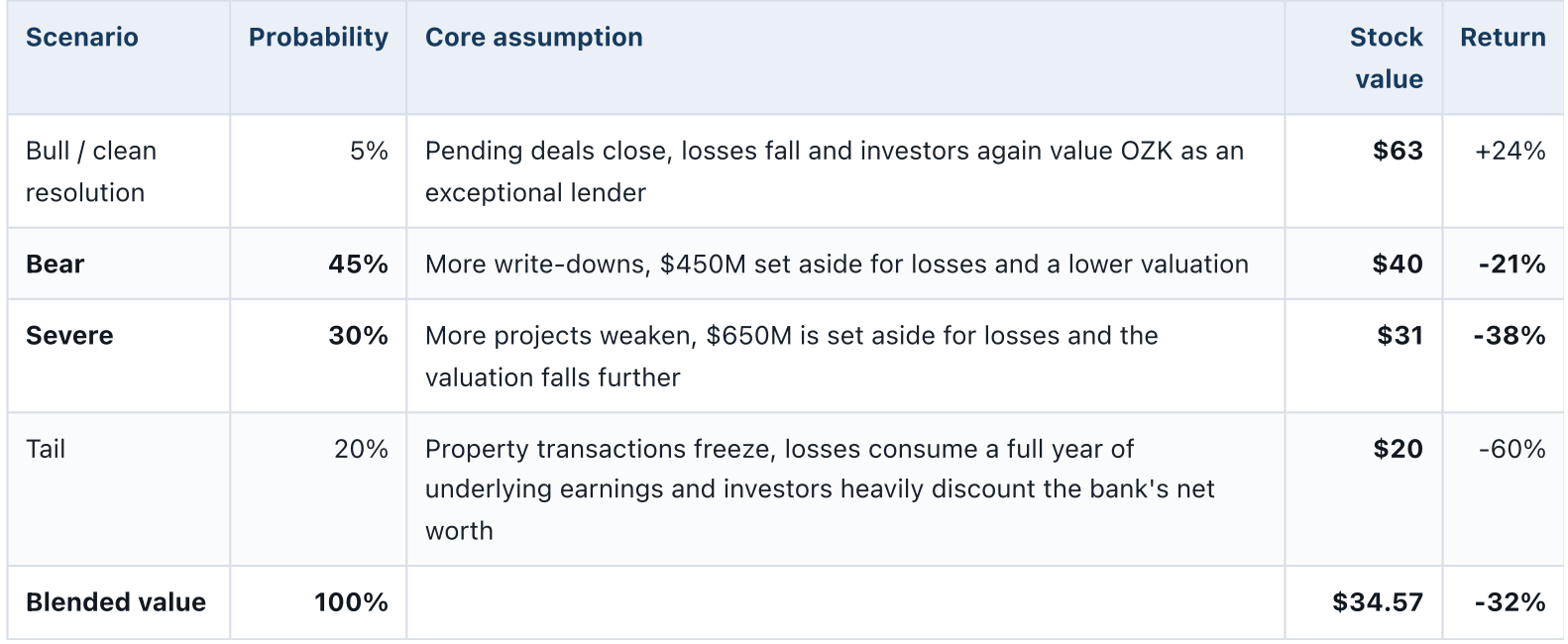
My view is simple: this is a can-kicking story reaching its final stage. OZK can absorb losses, while shareholders remain exposed to falling profits and investors no longer treating the bank as an exceptional lender. As the last extensions mature and the weakest projects face real buyers and long-term lenders, the stock can reprice toward the $34.57 blended value across the four scenarios.
Disclaimers
This analysis is based solely on public information and is for informational purposes, not investment advice. Readers should conduct their own diligence. Outlier Capital’s position disclosure and full disclaimer appear at the end of this report. Updated July 23, 2026 after reviewing Bank OZK’s full 2Q26 management comments, financial supplement and earnings call. Scenario losses, probabilities and targets are author estimates.
As of the publication date, Outlier Capital holds a short position in Bank OZK (NASDAQ: OZK) and may benefit if the price of OZK securities declines. Outlier Capital may buy, sell, cover, increase, reduce, hedge or otherwise change its exposure at any time, for any reason and without notice. Its position may have changed after this report was published.
This report reflects the opinions of Outlier Capital as of the publication date. Those opinions, estimates, price targets, scenarios and probabilities are subject to change without notice. Outlier Capital assumes no obligation to update this report or announce subsequent changes in its views or positions.
This material is provided solely for informational and educational purposes. It is not investment, legal, tax, accounting or other professional advice; an offer or solicitation to buy or sell any security; or a recommendation that any person enter into any transaction. Readers should conduct their own independent research and consult their own professional advisers before making investment decisions.
The report relies on publicly available information believed to be reliable. Outlier Capital makes no representation or warranty, express or implied, regarding its accuracy, completeness or timeliness. The analysis may contain errors or omissions. All forward-looking statements, forecasts and model outputs involve assumptions and uncertainties, and actual events or results may differ materially.
Investing in securities involves substantial risk, including the possible loss of principal. Short selling involves additional risks, including theoretically unlimited losses, borrowing costs, dividend obligations, recalls and short squeezes. Past performance, where referenced, does not guarantee future results.