


The real estate market is running out of time. And when I say real estate market, I mean the housing market and commercial real estate.
The market for both has been in steady decline for years. I have closely been following this decline and have heard from the industry constantly that it will get better soon, yet it has consistently gotten worse. It shocks me that it has continued to deteriorate and is barely being paid attention to.
Since the beginning of 2025, I have held short positions to express my view on real estate, with Lennar (LEN) being my largest short. Through this entire time, management teams and the industry at large have consistently misled investors and kicked the can down the road. Now time is running out, and the industry can no longer lie to itself.
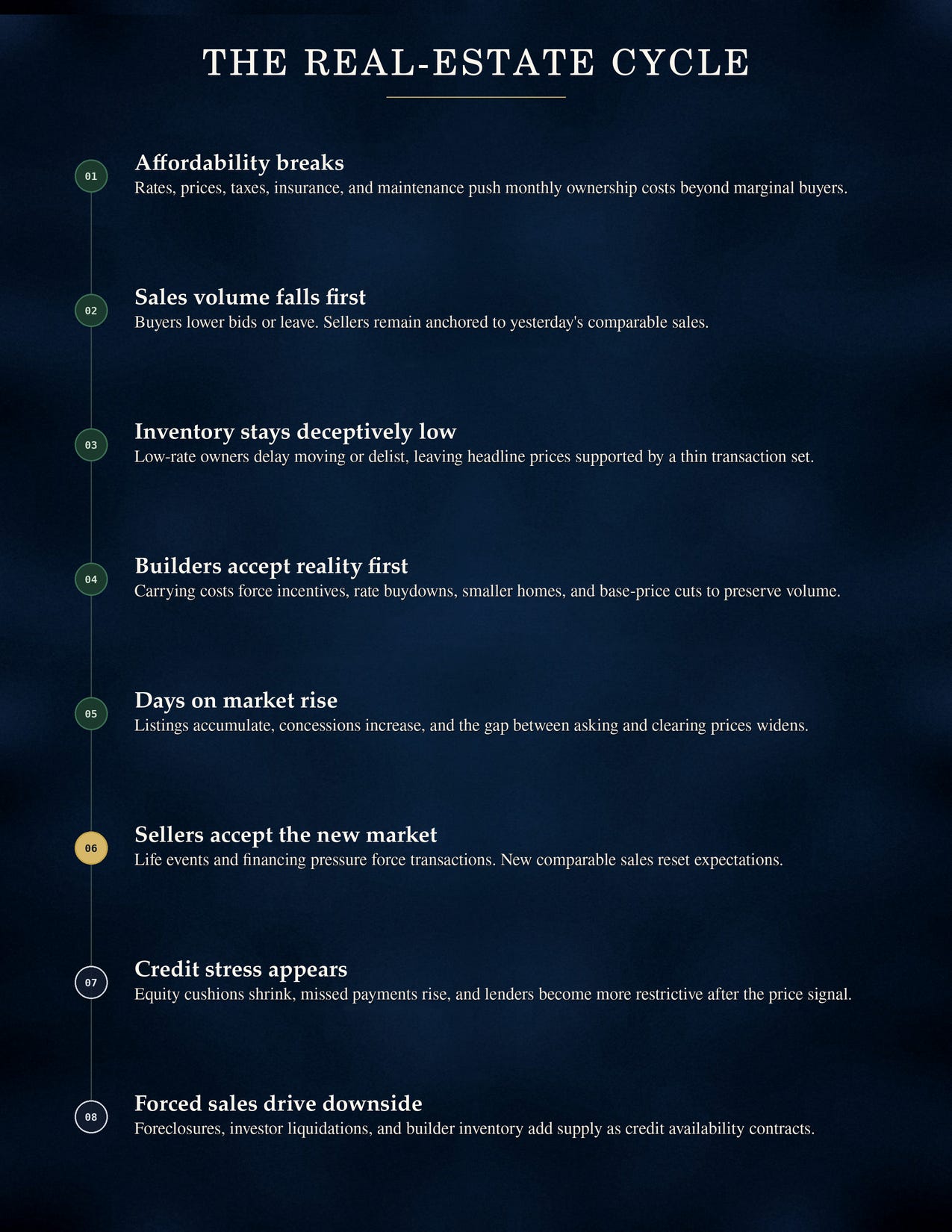
Real estate cycles are long and slow. They are different than stock market crashes that happen quickly and you very clearly see it with numbers on a screen. If you don’t pay attention to how things are trending, and what is affecting it, you will wake up one day and it will seem like it happened overnight.
Covid Boom
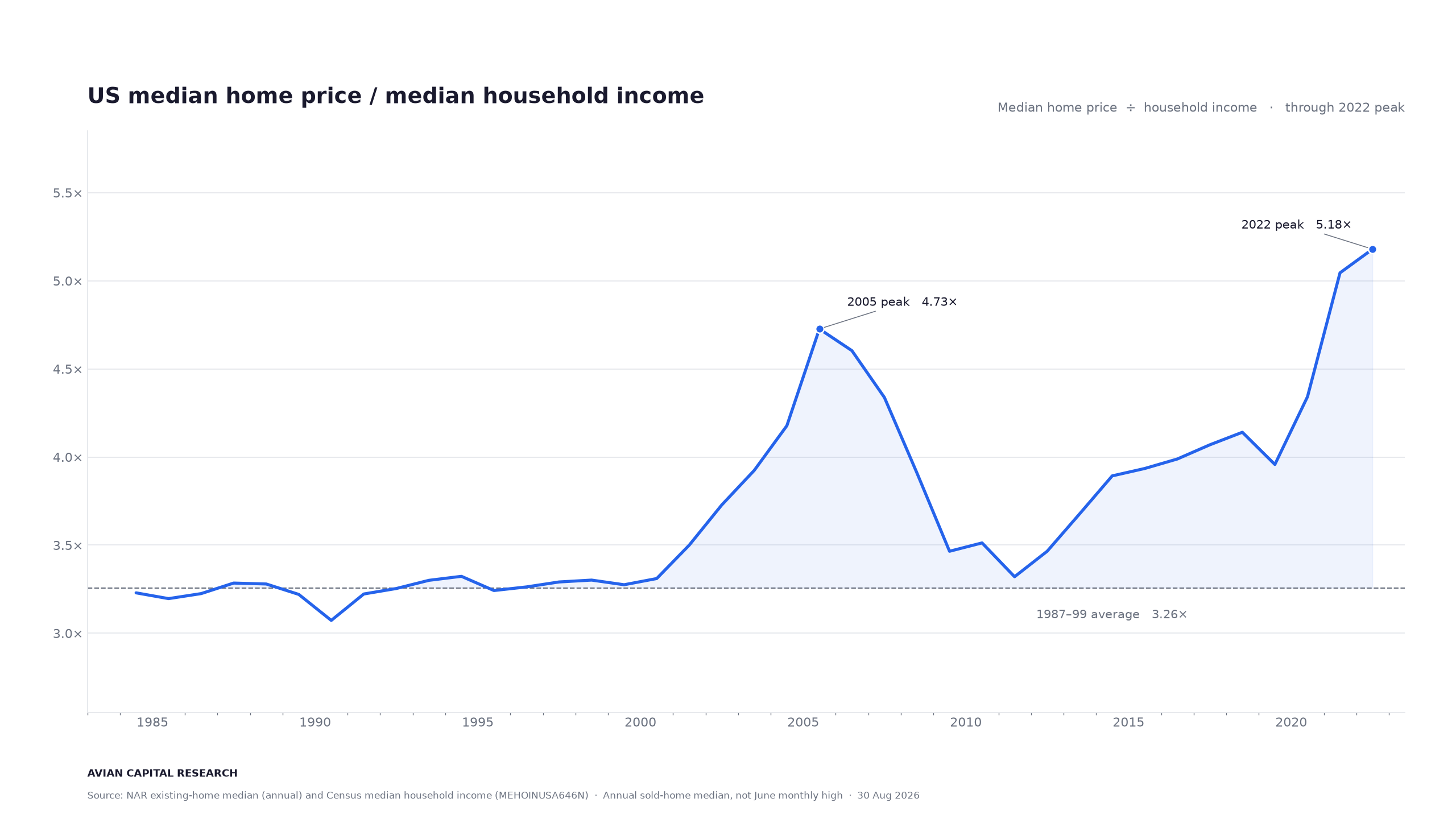
In 2020-2021 we had historic levels of money printing, people were locked at home, and rates were the lowest in history.
Investor speculation caused home prices to experience the most rapid rise in history. Home prices relative to incomes, rose to levels higher than the previous real estate bubble. Why people haven’t been calling it a bubble this time? I am not sure.
During this time, social media became flooded with real estate “gurus” telling people to buy real estate for passive income and financial freedom.
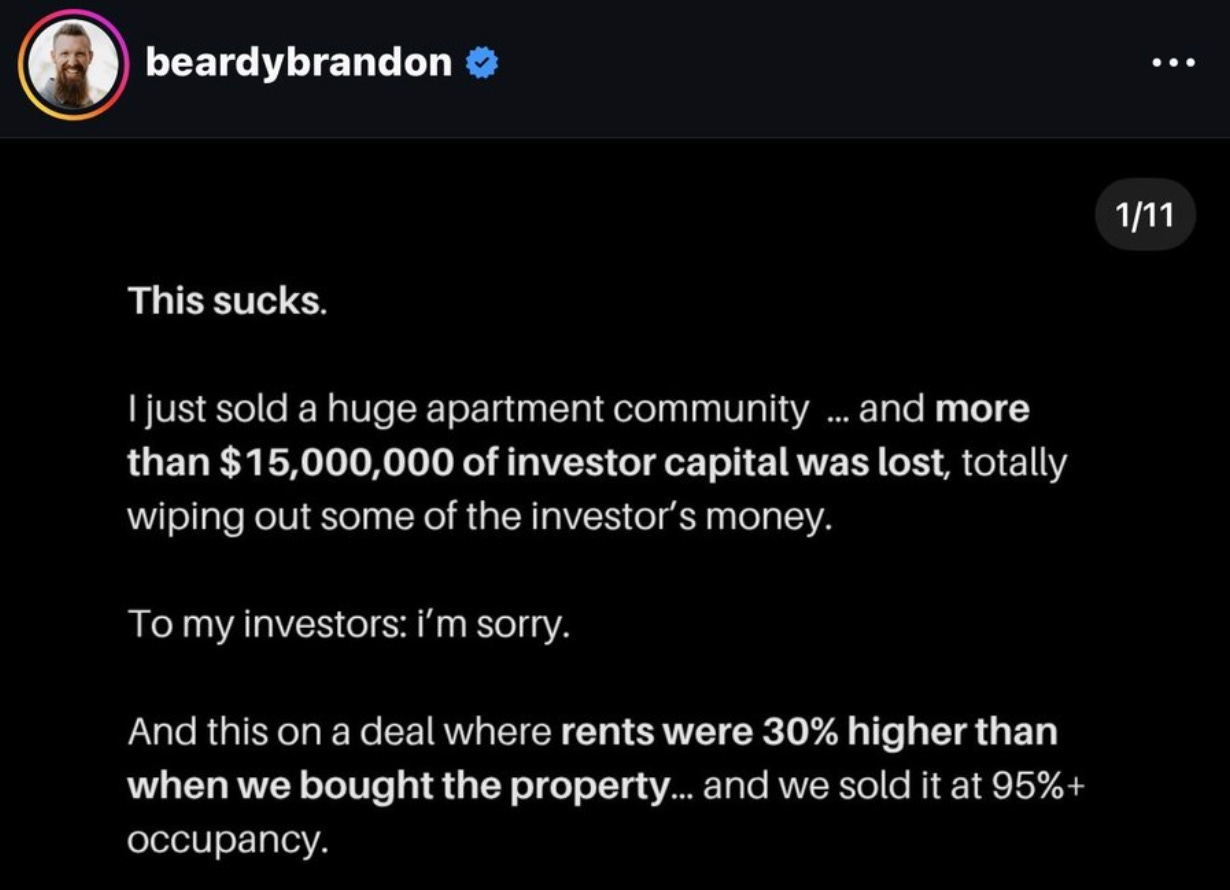
One of the most popular gurus during this time was Brandon Turner, the host of BiggerPockets. Brandon had a huge influence on a whole generation of mom and pop investors to pile in to single family, multifamily, and short-term rental real estate.
Recently, he lost $15M of investor capital. It is quite symbolic when the guru who inspired a whole generation of investors to get in, is losing his investors’ money.
Foreclosure Suppression
There is another reason the housing market has looked healthier than it really is. For five years, foreclosures were artificially suppressed. This is something so massive yet it never got any attention from the media.
During Covid, the CARES Act let borrowers pause mortgage payments through forbearance, and federal moratoriums blocked foreclosures outright. When those expired, the government kept these going through “loss mitigation” programs. This was extended and extended till it finally sunset in October, 2025.
This was extended far beyond what it was originally intended for. Relief from the pandemic lockdowns turned into kicking the can down the road to deal with the foreclosures years later.
It is now years later. Foreclosure filings hit about 228,000 properties in the first half of 2026, up 21% year over year. Five years of delayed distress is hitting the market with no demand to absorb it.
DSCR Loans and the Airbnb Bust
People love to say that there could never be a subprime mortgage crisis, because there aren’t NINJA loans that exist today. What those same people have never heard of are DSCR loans which are not too far off.
DSCR (Debt Service Coverage Ratio) loans are loans for investors who use the property’s projected rental income to qualify the property, rather than a person’s liabilities and income. As long as the lender sees that the projected cash flow of the property can cover the debt service by a certain amount, then the property qualifies.
On the surface, this may not seem too bad. But where this gets crazy is the fact that you can use AirBnB “projected rental income” to qualify a property.
If you aren’t sure why this is problematic, let me show you why:
Let’s say an investor wants to buy a property with a DSCR loan and the property earns $2,000 in projected rent, but has $2,000 in expenses. Well it wouldn’t qualify with a normal DSCR loan. But let’s say short-term projected rental income is used to qualify it. With aggressive occupancy assumptions, that $2,000 rent is now $4,000 and can qualify any property.
People were sold the dream of financial freedom by the gurus, and flooded to Airbnb investing. A wave of supply hit the market due to everyone piling in, and occupancy tanked. Now there is a wave of underwater Airbnbs that are trying to sell when there are no buyers.
Below is an example of one of the most popular areas the gurus suggested investing in (Joshua Tree, CA).

Sales Have Collapsed
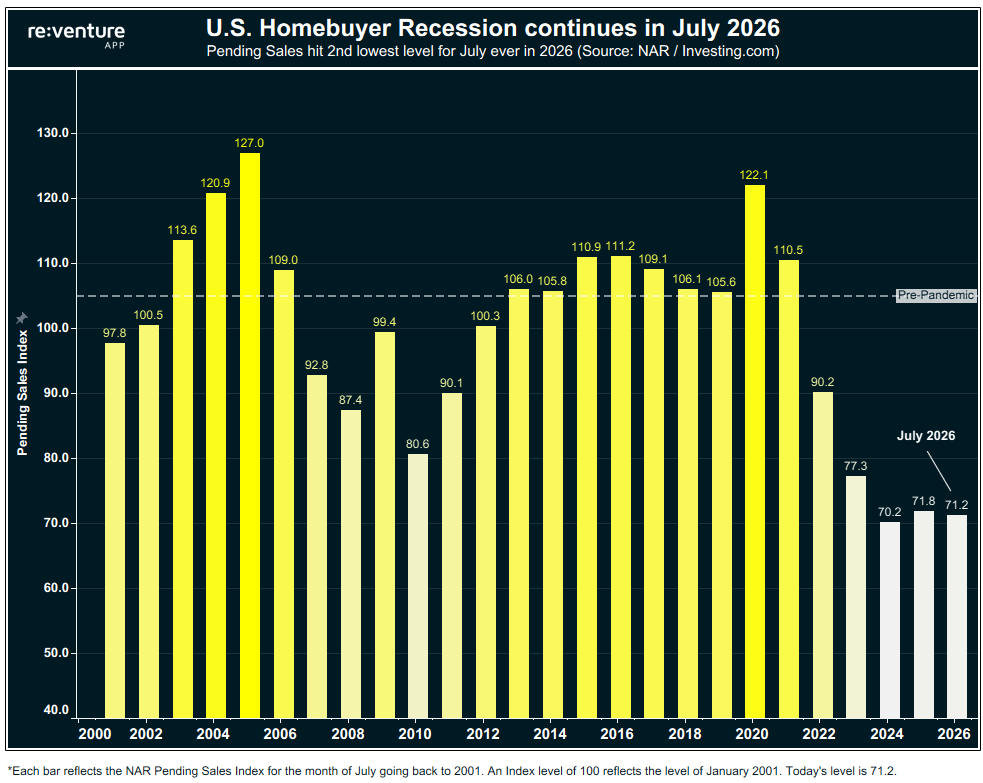
Pending sales are now lower than the great financial crisis. Sellers have been in denial over prices as demand has evaporated. Now, we are entering the phase where sellers are forced to face reality and lower prices to be able to have a chance of selling the property.
Homebuilders Lead the Decline
The housing market has been frozen for a while but many think home prices haven’t crashed yet. If you look under the hood, the downturn began long ago.
In the process of the downturn, the builders lead. They have a business that they must sell what they build. They do not have the luxury of being delusional for years. They have to face reality and are forced to lower prices to move inventory.
Median home prices have been masked by price cuts being hidden through incentives. The builders don’t want to lower prices so it doesn’t seem as bad on the surface, so instead they offer things such as mortgage rate buy downs, closing cost assistance, flex cash, design center credits, and move-in packages.
Lennar, the second-largest builder in the country, has average selling prices down 24% from the peak, back below pre-pandemic levels. That is much worse than a mild correction.
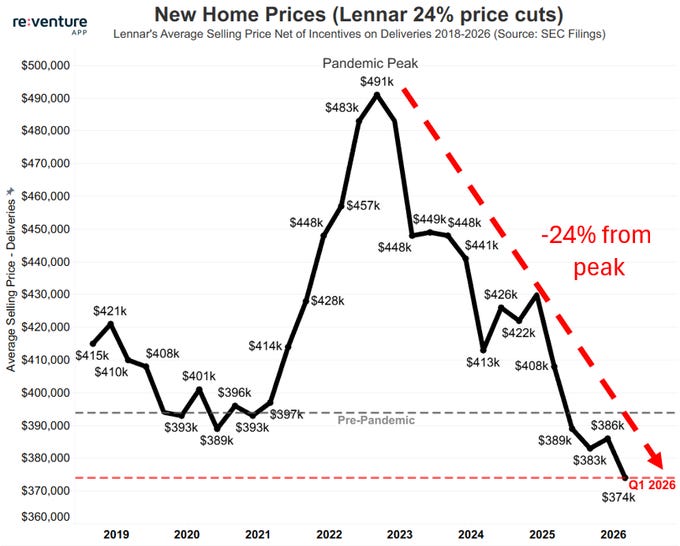
Where are we now?
After prices got to historically elevated levels, we got the sales collapse. Builders already accepted reality and average selling prices are crashing.
Now inventory is sitting, and we are entering the phase of forced sales driving downside. Through the wave of foreclosures beginning, underwater investment properties, and people having life events forcing them to sell, lower prices follow.
Commercial Real Estate
Commercial Real Estate is the other part of the story. This part could be a whole article in itself but I will keep it short and sweet for you to see what’s going on here.
Commercial Real Estate is different than housing in the sense that it’s simply math. It has revenue (rent), operating expenses (maintenance, property management, taxes, insurance), and interest expense.
Most of the industry operates the same way when modeling investments. Assume X% rent growth, slightly lower growth in expenses, with no assumption on interest rates.
Because interest rates were so low, this caused a similar boom that the housing market experienced from investors. The problem is that the math ended up looking a lot different than what was assumed when purchased.
Rent did not grow as assumed (in many cases declined)
Expenses grew much more than anticipated
Cost of debt skyrocketed
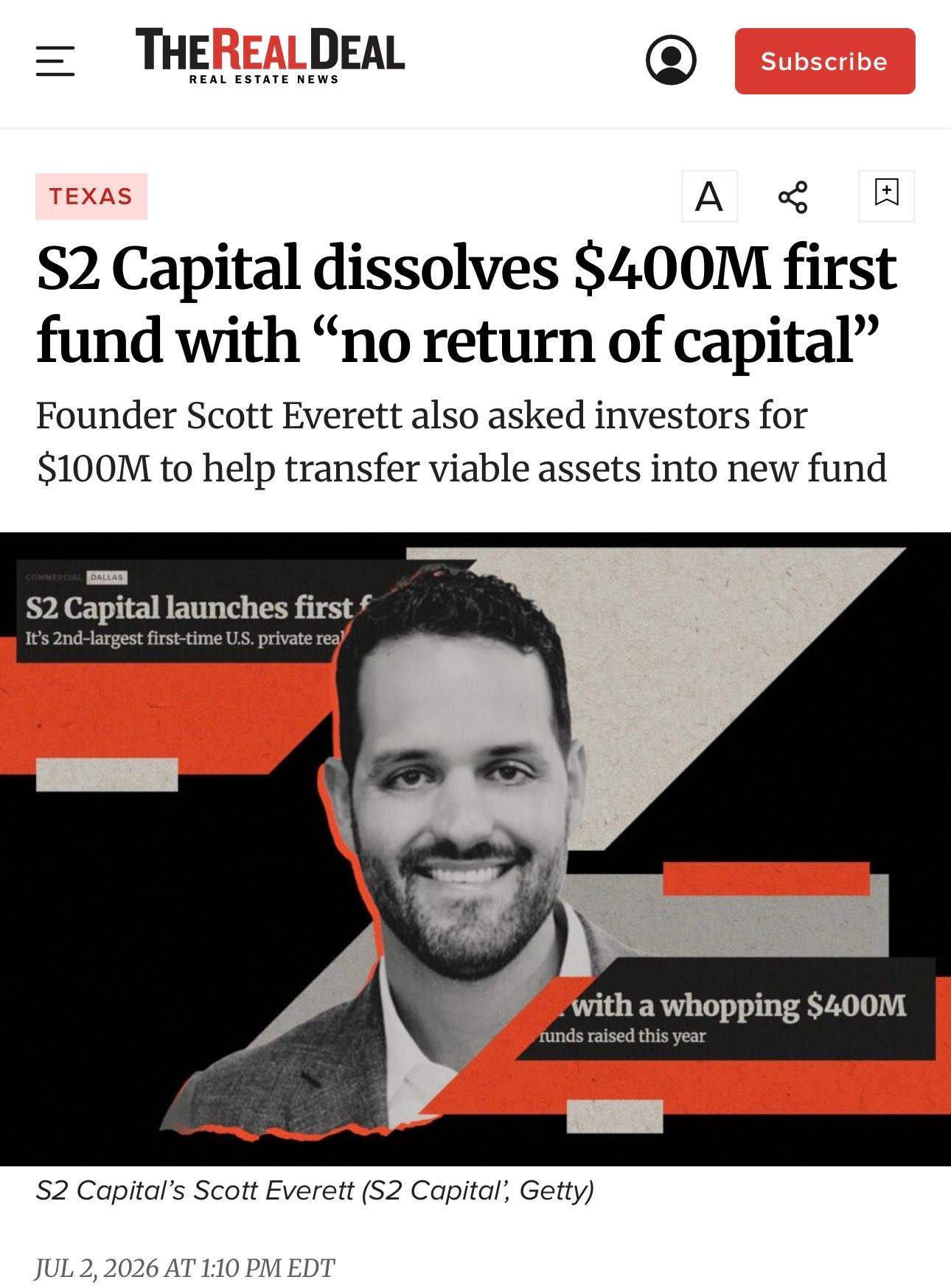
Take S2 Capital, a $400M multifamily fund that lost every dollar of investor capital.
On average, operating expenses were up 16%, rents down 24% and interest expense up 50%
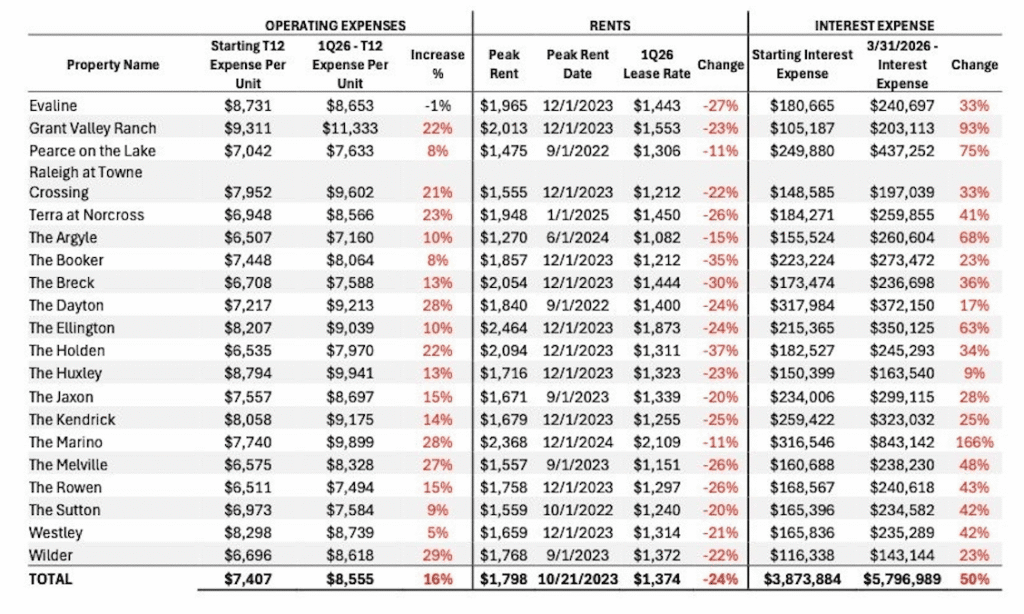
This is not just one fund that made bad decisions. This is widespread across the asset class.
This was a multifamily fund. Most people think it’s only office that’s under stress, but office was just the first to go. Now multifamily, retail, and hotels are under stress.
The Data
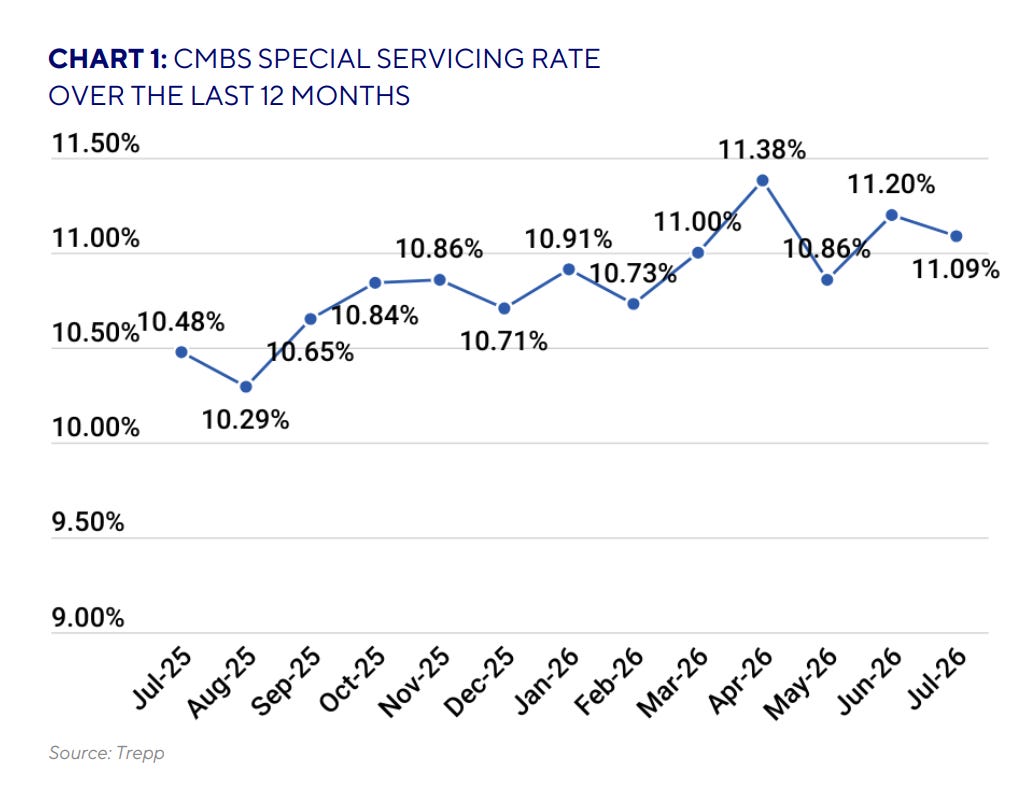
CMBS (Commercial Mortgage Backed Securities) are the best way to get a real time pulse on the CRE market. CMBS 30+ Days marked as delinquent just spiked to 7.86%
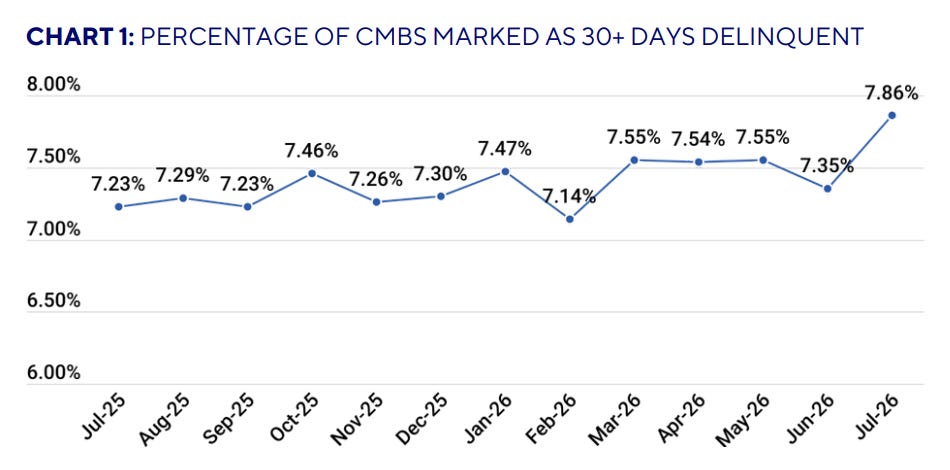
This alone is alarming, but what is even more alarming is when you look at the special servicing rate. The special servicing rate is the percentage of total outstanding CMBS loans that have been transferred to a special servicer due to distress, default, or anticipated default:
The Maturity Wall
The entire industry was built on the assumption that rates fall forever. The real estate industry has been saying for years “rates will come back down” yet they have continued to rise.
Right as the asset class grew to a gargantuan scale, we are finding out what happens when yields rise and remain elevated for a sustained period of time.
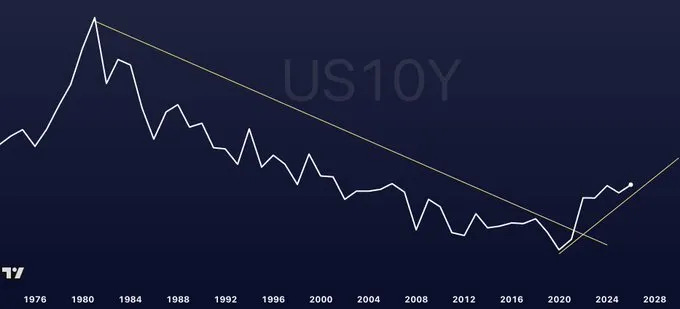
The reason why this is problematic is because most commercial real estate loans have balloon payments, where 5 years after the loan begins, the entire balance comes due, and the borrower has to refinance into a new loan or sell the property to pay off the previous loan.
When you have to refinance from historically low rates into much higher rates, the math no longer makes sense.
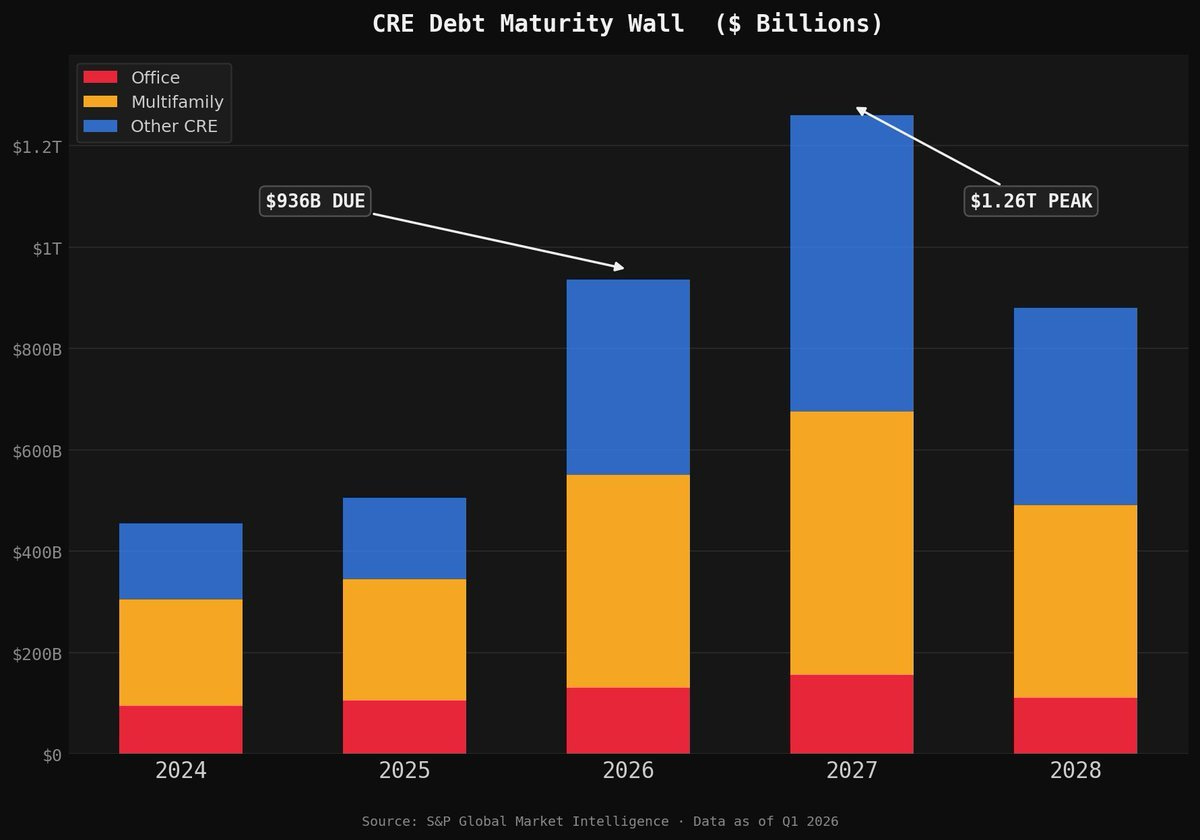
As you can see, in the graphic above, office is a small portion of the maturity wall, which already has a double digit default rate. The maturity wall is hitting multifamily and the rest of CRE.
This is why commercial real estate is a ticking time bomb. Some commercial real estate has been in this situation or worse for years, and lenders have allowed the can to be kicked down the road by offering loan modifications, hoping that conditions will improve soon.
“Extend and pretend” - exactly what was happening in the great financial crisis.
See for Yourself
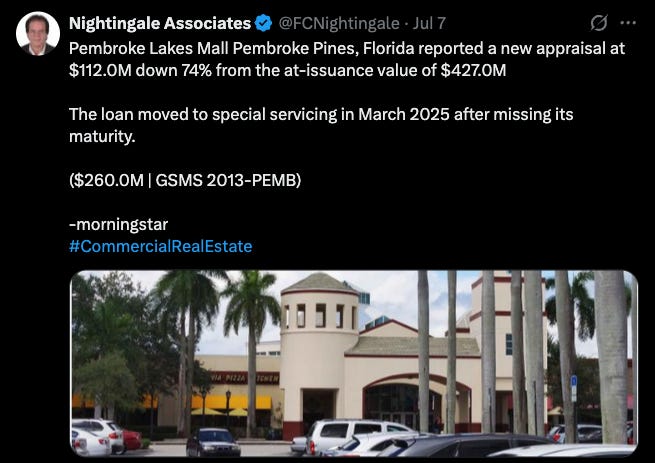
Nightingale Associates on X has been posting the stress in the commercial real estate market, daily, for years now. If you want to see firsthand, what is going on in the market, have a scroll through his account, and you will be astonished.
Where are we now?
CRE is further along than housing. Office went first. Multifamily, retail and hotels are in it now. Delinquencies and special servicing rates are already at extremely alarming levels, and we are entering a massive maturity wall.
Why does this all matter?
There is $87 trillion in this asset class. That is almost 3x GDP. A downturn does not stay in real estate. It has many downstream effects. An obvious example is the wealth effect. Households are sitting on $53 trillion of it, and the top-end consumer cuts spending when that marks down. Even if you do not care about real estate directly, this affects everything.
The large banks have about 13% of their balance sheets in commercial real estate. The regionals have about 44%. The big banks originated this stuff and sold it. The regionals originated it and kept it. So when the 2021 debt comes due, and the borrower can’t refinance because the 10-year never came back down, it is not JPMorgan eating it. It is the bank down the street, whose whole business was local CRE.
The slice that did leave the banks went into private credit, which does not mark to market and will tell you everything is fine until it isn’t. Fitch has private credit defaults at a record 6%. The large banks are still in that trade: they just relabeled it as credit lines to the funds.
Regionals stop lending, CRE can’t refinance, homebuilders already have to cut prices to move inventory, and $53 trillion of household real estate starts working in reverse.
The can has been kicked since 2022. This is the part where there is no more road.
Contact:
If you are an accredited investor interested in investing in Avian Capital, please fill out the contact form at aviancap.com
Disclaimers:
This is for informational and educational purposes only. It is not investment advice, a recommendation, or an offer to buy or sell any security.
As of the date of publication, Avian Capital and/or its principals hold short positions in real estate related securities, including Lennar (NYSE: LEN), and may benefit if those prices decline. Positions may be increased, reduced, covered, or otherwise changed at any time without notice, and may have changed after this was published.
This reflects my views as of the publication date. Those views are subject to change. I have no obligation to update this post.
The analysis relies on publicly available information believed to be reliable. I make no representation that it is accurate or complete. Forward-looking statements involve assumptions that may be wrong. Actual results may differ. Short selling involves substantial risk, including theoretically unlimited losses. Past performance does not guarantee future results.
Great summary. Thanks for putting this together.